
For more than two decades, productivity software has defined how professionals work. We open apps to write emails, manage tasks, send messages, update dashboards, and organize projects. Each action forces us to switch platforms, type manually, copy content, reformat text, and repeat the same steps across different tools.
Intelligent agents in productivity software are now changing how professionals work in 2026 by replacing this manual effort with context-aware AI that executes tasks across platforms.
Despite the explosion of new apps and tools, the underlying model of work has remained the same. We are still responsible for operating software step-by-step.
The real problem today is not the lack of tools. It is the effort required to use them.
This is where intelligent agents enter the picture.
Instead of humans navigating software manually, intelligent agents understand user intent, recognize context, and take action across platforms on behalf of the professional. This marks a fundamental shift from tool-based productivity to agent-driven productivity.
Traditional productivity software is no longer the center of modern work. Intelligent agents are.
Why Intelligent Agents in Productivity Software Are Replacing Traditional Tools
Productivity tools were designed around a simple assumption: the human is responsible for operating the software.
Whether it is Gmail, Slack, LinkedIn, CRM dashboards, or project management apps, the workflow always follows the same pattern:
You think → you type → you edit → you copy → you paste → you format → you send.
Even with AI writing assistants, this process remains fragmented. AI may generate text, but you still have to manually place it into the right platform, adjust tone, and complete the action yourself.
This constant manual operation creates what experts now call workflow friction – the invisible time lost in repeated, mechanical steps that do not require thinking, only effort.
As the number of platforms increases, this friction multiplies
What Are Intelligent Agents?
Intelligent agents are AI systems designed not just to generate content, but to perform actions inside your digital environment.
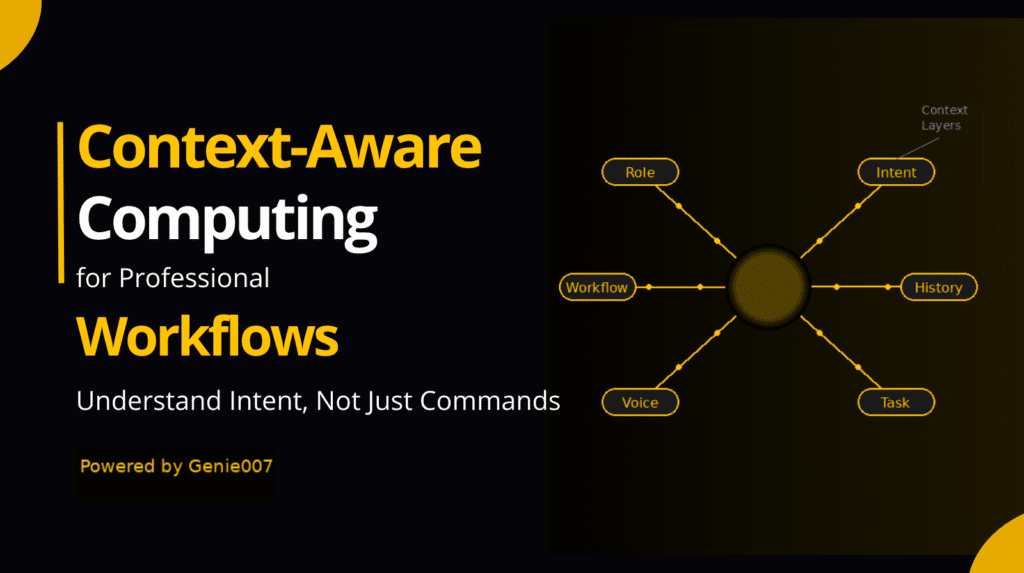
They do not wait for prompts inside a chat window. They understand:
- Where you are working (context)
- What you are trying to do (intent)
- Which platform you are using (environment)
- What outcome you want (execution)
This ability allows them to move beyond writing assistance into workflow execution.
Instead of asking, “What should I write?”, professionals can now say, “Reply to this email professionally,” and the agent handles drafting, formatting, and placing the response directly inside the email window.
The difference is subtle but powerful: the agent becomes the operator of the software.
The Shift from Tools to Agents
Traditional tools require users to learn interfaces, buttons, and workflows. Intelligent agents remove this learning curve by operating in natural language and voice commands.
This shift can be summarized simply:
| Traditional Tools | Intelligent Agents |
|---|---|
| User operates the software | Agent operates the software |
| Manual typing and formatting | Automated execution |
| Switching between apps | Cross-platform actions |
| Copy-paste workflows | Direct placement of output |
| Interface-driven | Context-driven |
This is why many experts describe 2026 as the year productivity software begins to feel outdated.
Why This Shift Is Happening Now
Several technological advances have made intelligent agents possible:
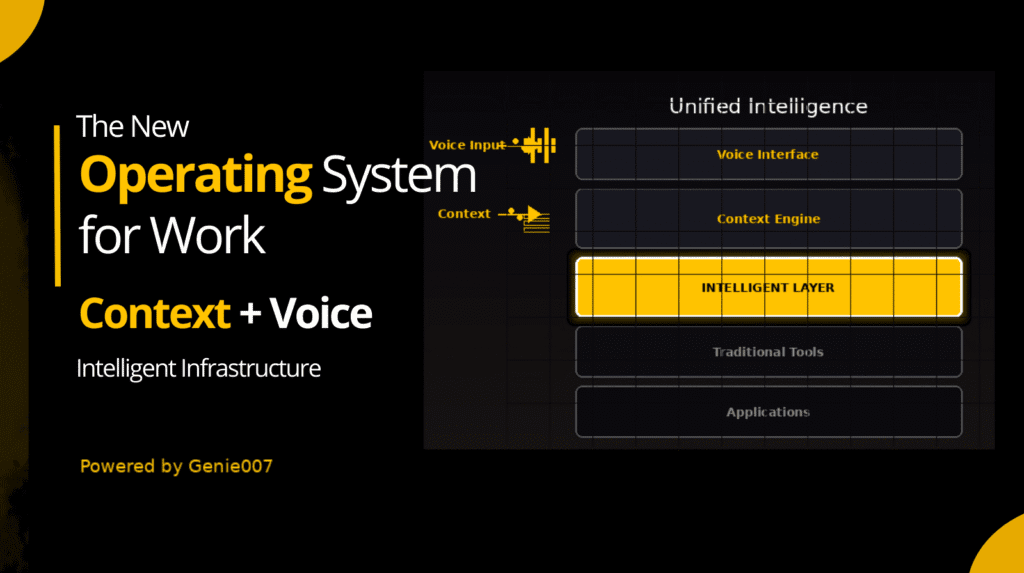
1. Context-Aware Computing
AI can now understand what is on your screen and where you are working.
2. Natural Language Understanding
Commands no longer need to be structured prompts. Normal speech is enough.
3. Browser-Native Integration
Agents can operate directly within web platforms instead of separate apps.
4. Voice-First Interfaces
Speaking is faster than typing, allowing intent to be captured instantly.
Together, these capabilities allow intelligent agents to remove the operational burden from professionals.
The Hidden Cost of Operating Software Manually
Most professionals underestimate how much time is spent on micro-tasks:
- Rewriting the same type of emails daily
- Adjusting tone for LinkedIn messages
- Formatting social posts for each platform
- Updating CRM after calls
- Switching between tabs to gather information
These tasks do not require creativity or decision-making. They require effort.
Over a week, these micro-tasks can consume 8–12 hours – time that could be spent on strategy, communication, and meaningful work.
Intelligent agents target exactly this wasted time.
From Writing Assistance to Workflow Execution
Earlier AI tools focused on improving writing quality. Tools like Grammarly, transcription software, and chatbots help generate or correct text.
But they stop at content.
Intelligent agents go further. They complete the workflow:
- Drafting the content
- Placing it in the correct platform
- Formatting it appropriately
- Executing the action
This end-to-end capability is what separates agents from assistants.
How Genie 007 Represents This New Category
Genie 007 is an example of how intelligent agents are redefining productivity. Instead of being another writing tool, it functions as a voice-to-action AI agent inside your browser.
It understands whether you are in Gmail, LinkedIn, Slack, or a dashboard and performs tasks directly in those environments through simple voice commands.
This eliminates:
- Manual drafting
- Copy-paste between tools
- Constant tab switching
- Repetitive formatting work
The professional no longer operates the software. The agent does.
The Impact on Professional Workflows
As intelligent agents replace traditional tools, several changes occur in how work is done:
- Communication becomes faster because it is spoken, not typed.
- Multitasking reduces because agents handle mechanical steps.
- Mental fatigue decreases due to less context switching.
- Response time improves across all platforms.
This leads to measurable improvements in productivity without increasing effort.
Why Traditional Productivity Software Will Feel Outdated
Just as smartphones replaced feature phones by removing friction, intelligent agents are replacing traditional tools by removing operational effort.
In a few years, manually drafting emails, copying text between apps, and formatting posts may feel as outdated as manually dialing phone numbers.
The expectation will shift from “How do I do this?” to “Tell the agent to do this.”
The Future of Work Is Agent-Driven
The rise of intelligent agents signals a broader transformation in the workplace. Software will still exist, but it will no longer be the primary interface between humans and digital work.
Agents will sit on top of software, acting as intermediaries that translate human intent into digital action.
This is not an incremental improvement. It is a structural change in how professionals interact with technology.
Conclusion
For years, productivity improvements meant adding more tools. In 2026, productivity improvement means removing the need to operate those tools manually.
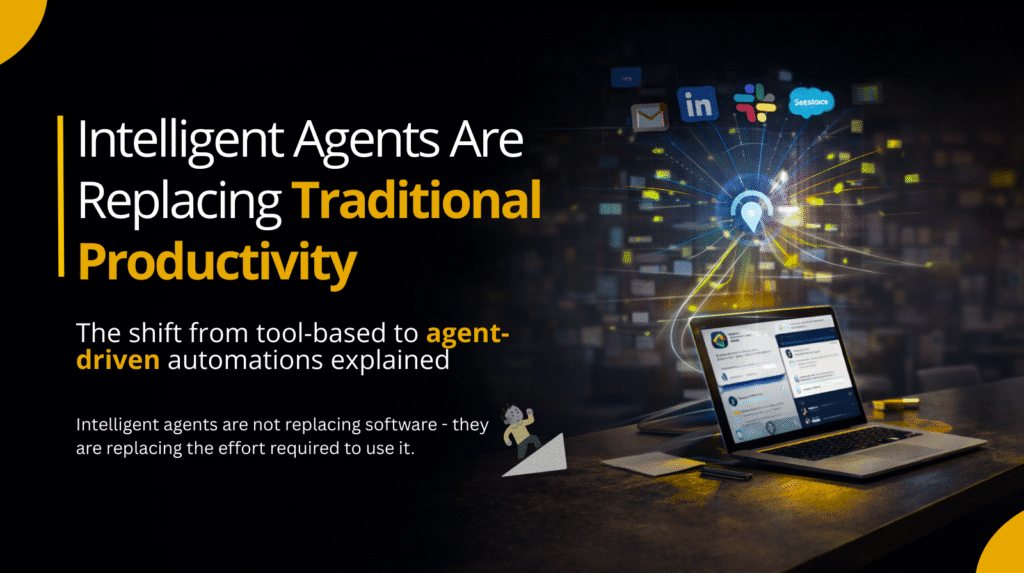
Intelligent agents are not replacing software – they are replacing the effort required to use it.
As professionals adopt agent-driven workflows, traditional productivity software will become secondary, operating quietly in the background while agents handle the execution.
This is the beginning of a new era where work is defined not by the tools we use, but by the intelligence that operates them for us.
FAQ – Intelligent Agents in Productivity Software
What are intelligent agents in productivity software?
Intelligent agents in productivity software are AI systems that understand user intent and execute tasks across platforms automatically instead of requiring manual operation.
How are intelligent agents different from traditional AI tools?
Traditional AI tools generate content, while intelligent agents complete the entire workflow by placing, formatting, and executing actions inside applications.
Why are intelligent agents important for modern professionals?
They reduce workflow friction, save hours of manual work, and allow professionals to focus on thinking instead of operating software.
Can intelligent agents work across Gmail, Slack, and LinkedIn?
Yes, context-aware intelligent agents can understand where you are working and perform actions directly inside these platforms
Are intelligent agents replacing productivity software?
They are not replacing software but replacing the effort required to use that software manually.
How does Genie 007 use intelligent agents for productivity?
Genie 007 uses a voice-enabled, context-aware intelligent agent that executes tasks across platforms directly from the browser environment.
Frequently Asked Questions
How does voice typing compare to keyboard typing?
Most people type at 30-40 WPM but speak at 130-150 WPM. Voice typing with Genie 007 is 3-4x faster with 99.5% accuracy.
Does Genie 007 work on any website?
Yes. Any text field — Gmail, Slack, Notion, LinkedIn, GitHub, Google Docs, and hundreds more.
Is voice dictation private?
Genie 007 processes all audio locally. No recordings stored or sent externally. GDPR compliant, HIPAA ready.
Ready to Try Voice-to-Action?
Install Genie 007 free — no credit card required. Works on any website, any text field.
Install Genie 007 Free →Your privacy matters. Genie 007 processes all audio locally on your device with no recordings stored on external servers. Read the full security and privacy policy for complete details.
Business leaders looking for executive-level automation should explore AI workflow agents for CEOs.
Business leaders can explore how AI workflow agents help CEOs automate executive tasks.
Written by Bill Kiani, founder of Genie 007.