
Modern work is evolving at an unprecedented pace that challenges traditional assumptions about enterprise technology. Organizations today deploy more sophisticated digital tools than at any point in human history, yet paradoxically, productivity challenges continue to intensify rather than diminish. The average knowledge worker navigates between CRM systems, collaboration platforms, support dashboards, internal portals, project management tools, and communication channels dozens-sometimes hundreds-of times throughout a single workday.
While these individual applications are undeniably powerful in isolation, their collective impact often creates fragmented, disjointed workflows that slow decision-making, increase cognitive load, and amplify operational complexity rather than reducing it. This fragmentation represents one of the most significant hidden costs in modern enterprise operations.
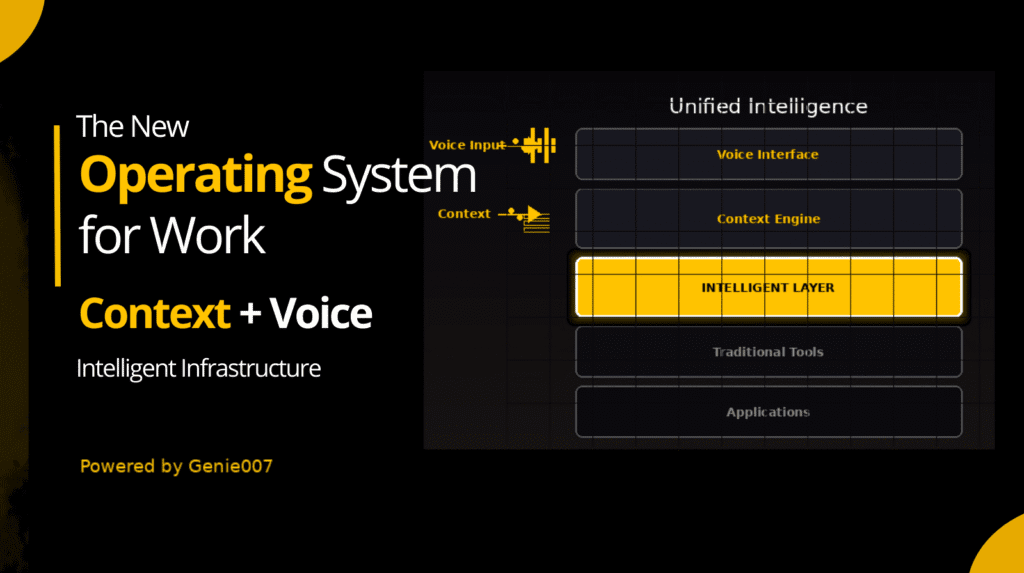
This is precisely why a transformational paradigm is emerging across forward-thinking enterprises worldwide: context-aware, voice-driven intelligence is rapidly becoming the new operating system for modern work.
Instead of perpetually forcing professionals to adapt their work patterns to inflexible software requirements, the next generation of enterprise technology fundamentally inverts this relationship-adapting intelligently to users’ natural work patterns, communication styles, and contextual needs. Context and voice are no longer optional premium features or nice-to-have enhancements. They are becoming the essential foundational infrastructure that powers intelligent, seamless, and increasingly autonomous workflows across global enterprises.
This shift is already actively shaping the strategic directions of global technology leaders including Microsoft, Google, Amazon, and emerging AI-first companies. For organizations that aspire to remain competitive in rapidly evolving markets, understanding this fundamental transformation isn’t merely valuable-it’s essential for survival and growth.
The Critical Problem: Modern Workflows Are Fragmented and Profoundly Inefficient
Despite organizations investing billions of dollars annually in digital transformation initiatives, enterprise software portfolios, and automation technologies, many face a frustrating paradox that defies conventional wisdom about technology adoption.
They possess more tools, more automation capabilities, and more data than ever before in organizational history. Yet simultaneously, employees report spending more time managing, navigating, and coordinating systems instead of completing the meaningful, value-creating work they were actually hired to perform.
The Daily Reality of Fragmented Digital Workflows
Research indicates that modern knowledge workers typically:
- Switch between applications 30-50 times daily, with some roles requiring 100+ application switches per day
- Repeat identical information across disconnected platforms because systems don’t share context or communicate effectively
- Spend 19% of work time searching for knowledge buried in disconnected systems, multiple databases, and siloed repositories
- Manually coordinate processes that should be automated, wasting hours weekly on administrative overhead
- Navigate complex, unintuitive interfaces that create unnecessary friction and slow productivity
- Re-explain context repeatedly to different systems, teams, and departments
- Manage notification overload from competing applications demanding attention
The Compounding Cost of Fragmentation
This systemic fragmentation creates multiple compounding negative effects:
Cognitive Overload: Constant context switching depletes mental energy and reduces focus quality. Research shows it takes an average of 23 minutes to fully regain concentration after each interruption or context switch.
Reduced Efficiency: Time spent navigating between tools, searching for information, and re-establishing context represents pure waste-activities that create zero value for customers or the organization.
Slower Business Outcomes: Fragmented workflows delay decisions, extend process completion times, and reduce organizational agility in responding to market changes.
Employee Frustration and Burnout: Professionals increasingly report that technology intended to help them actually creates more stress, complexity, and frustration.
Innovation Stagnation: When teams spend excessive time managing tools rather than thinking strategically, innovation suffers dramatically.
The Root Cause: Lack of Intelligent Coordination
The fundamental problem isn’t insufficient technology deployment or inadequate software capabilities. Organizations already possess powerful tools. The root issue is the systemic lack of intelligent coordination between systems.
Traditional enterprise software operates on a fundamentally flawed assumption: treating each user interaction as an isolated, independent event with no connection to previous activities, ongoing workflows, or broader organizational context.
Users must constantly guide systems manually, provide context repeatedly, explain their intent explicitly, verify their identity across platforms, and perform redundant tasks that intelligent systems should handle autonomously. As organizational complexity increases and tool portfolios expand, this model becomes progressively more unsustainable.
This is precisely where context-aware intelligence combined with voice interaction fundamentally changes the rules of enterprise productivity.
The Evolution: From Software Tools to Intelligent Infrastructure
Enterprise technology has progressed through distinct evolutionary stages, each representing a meaningful advance in capability and sophistication.
Stage 1: Standalone Applications (1980s-1990s)
Early enterprise software consisted of independent applications solving specific, isolated problems. Word processors, spreadsheets, databases, and email operated as separate tools with minimal integration. Users manually transferred information between systems.
Limitation: No coordination between applications. Each tool required separate learning and manual data transfer.
Stage 2: Integrated Platforms (2000s-2010s)
Organizations adopted integrated enterprise platforms-ERP, CRM, HRIS systems-designed to connect related workflows within functional areas. APIs enabled limited communication between systems.
Limitation: Integration remained technical rather than intelligent. Systems connected but didn’t understand user context, intent, or workflow state.
Stage 3: Intelligent Infrastructure (2020s-Present)
Today, leading organizations are entering a transformational new phase where the primary interface evolves from dashboards and menus to an intelligent orchestration layer that understands user goals, environmental context, organizational workflows, and optimal execution paths.
In this emerging model, intelligent infrastructure operates across all enterprise systems, autonomously orchestrating tasks, proactively retrieving relevant information, executing routine processes, and guiding users toward successful outcomes without requiring constant manual intervention.
Context-aware voice AI represents the enabling technology making this transformation from fragmented tools to unified intelligent infrastructure practically achievable at enterprise scale.
Understanding Context and Voice as an Operating System

The concept of “operating system” carries specific technical meaning that illuminates why this analogy accurately describes the transformational role of context and voice in enterprise environments.
What Operating Systems Actually Do
Traditional computer operating systems (Windows, macOS, Linux) don’t merely run software applications. They perform critical coordinating functions:
- Resource Management: Allocating memory, processing power, and storage across competing applications
- Process Coordination: Managing multiple simultaneous processes and ensuring they don’t conflict
- Unified Interface: Providing consistent interaction patterns across diverse applications
- Abstraction Layer: Hiding technical complexity from users while enabling sophisticated functionality
- Security and Access Control: Managing permissions, authentication, and data protection
How Context and Voice Function as an Operating System for Work
Similarly, context-aware voice intelligence acts as a coordinating control layer across fragmented enterprise workflows, performing analogous functions:
Workflow Orchestration: Coordinating processes across multiple disconnected systems without requiring manual intervention or navigation.
Resource Coordination: Intelligently routing requests to appropriate systems, people, and data sources based on context, urgency, and availability.
Unified Interface: Providing a single, natural language interface that works consistently across all enterprise applications and processes.
Complexity Abstraction: Hiding technical details and system-specific quirks, presenting users with simple, goal-oriented interactions.
Contextual Access Control: Applying role-based permissions dynamically based on user identity, location, and request context.
The Practical Impact for End Users
Rather than opening multiple applications, navigating complex menu structures, and manually coordinating across systems, professionals interact with a single intelligent interface that:
- Understands who they are, their role, and current objectives
- Retrieves relevant data automatically across all connected systems
- Executes actions autonomously without requiring step-by-step instruction
- Provides proactive guidance based on real-time context and organizational workflows
- Learns from interactions to improve future performance continuously
This approach eliminates the perpetual need for navigation, manual coordination, and system-specific knowledge. Instead of learning software interfaces and procedures, users simply communicate naturally. The intelligent infrastructure handles complexity behind the scenes.
Why Context Forms the Essential Foundation of Intelligent Work
Context represents the critical differentiator that transforms reactive technology into genuinely intelligent systems capable of proactive assistance and autonomous operation.
The Limitations of Context-Blind Systems
Without contextual awareness, even the most technically advanced tools remain fundamentally reactive—waiting for users to provide complete instructions, unable to anticipate needs, and treating every interaction as a new, isolated event.
Context-blind systems cannot distinguish between:
- A CEO requesting quarterly financial data versus an intern asking the same question
- An urgent customer issue requiring immediate escalation versus a routine inquiry
- The first time a user performs an action versus the hundredth repetition
- A request made during normal hours versus a critical after-hours emergency
The Comprehensive Dimensions of Enterprise Context
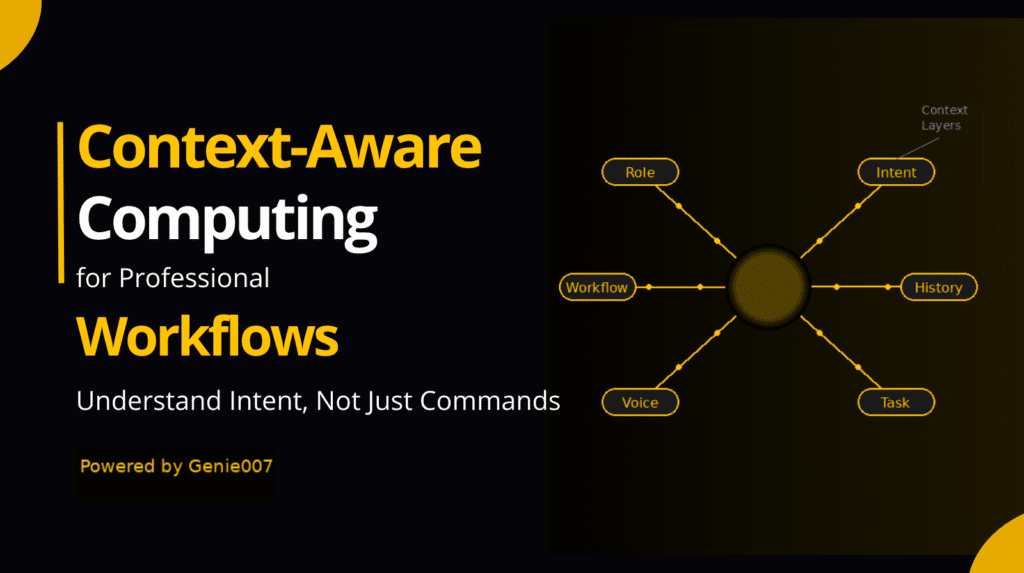
Truly context-aware systems understand multiple interconnected dimensions simultaneously:
Identity and Role Context:
- User identity, organizational position, and reporting structure
- Role-specific responsibilities and decision-making authority
- Access permissions, security clearances, and data restrictions
- Department, team membership, and functional area
- Geographic location and regional considerations
Historical and Relationship Context:
- Complete interaction history across all systems and channels
- Previous decisions, completed transactions, and ongoing processes
- Established preferences, customizations, and work patterns
- Relationship history with customers, vendors, and colleagues
- Performance patterns and behavioral tendencies
Current Activity and Intent Context:
- Active application, page, or workflow stage
- Immediate prior activities and navigation path
- Inferred objective based on behavior patterns and explicit statements
- Task completion stage within multi-step processes
- Related pending tasks and dependencies
Environmental and Situational Context:
- Physical location (office, home, field, traveling)
- Device type, capabilities, and connectivity status
- Time of day, day of week, and seasonal factors
- External events affecting operations (market changes, emergencies)
- Organizational state (quarter end, peak season, crisis mode)
Process and Workflow Context:
- Position within larger business processes and approval chains
- Dependencies on other systems, teams, or external parties
- Governance requirements and compliance obligations
- Service level agreements and deadline pressures
- Budget constraints and resource availability
How Context Enables Intelligent Personalization
When systems possess comprehensive contextual understanding, they can deliver genuinely personalized, proactive assistance that feels almost magical to end users.
Example: Information Request with Full Context
Traditional system response to “Show me the sales report”:
- Returns generic search results showing dozens of sales reports
- User must manually identify correct report, time period, and region
- Requires multiple clicks, filters, and verification steps
Context-aware intelligent system understanding:
- User is Regional Sales Director for Western Europe
- Request made during monthly review period (last week of month)
- User typically reviews preliminary results before team meetings
- Next scheduled meeting is tomorrow at 10 AM
- Last month user requested year-over-year comparison format
Context-aware system response:
“Here’s your Western Europe preliminary sales report for January 2026 with year-over-year comparison. Revenue is up 12.3% versus January 2025. Your team meeting is tomorrow at 10 AM—would you like me to generate the presentation deck now?”
This contextual intelligence reduces friction, accelerates workflows, and enables professionals to accomplish objectives in seconds rather than minutes.
The Continuous Learning Loop
Critically, contextual intelligence creates a self-improving feedback loop. Each interaction adds to the user’s contextual profile, making future interactions progressively more efficient, accurate, and personalized over time.
Systems learn:
- Which information users access most frequently
- Preferred communication styles and interaction patterns
- Typical workflows and process variations
- Decision-making patterns and priorities
- Exception handling preferences
This creates compounding productivity gains that accelerate over time rather than plateauing.
Why Voice Represents the Most Natural Interface for Modern Work
Voice interaction removes fundamental barriers created by traditional graphical user interfaces and keyboard-based input, enabling a more natural, efficient, and accessible mode of human-technology collaboration.
The Inherent Advantages of Voice Communication
Speed and Efficiency: Speaking is 3-4 times faster than typing for most users. Complex requests that require minutes to type accurately can be expressed in seconds through voice.
Natural Expression: Voice enables users to communicate in their own words, using natural language rather than learning specific commands, keywords, or interface-specific terminology.
Rich Contextual Signals: Spoken language carries information beyond literal words-tone, emphasis, urgency, emotion, and confidence all provide valuable contextual signals that text-based input misses entirely.
Cognitive Efficiency: Voice communication requires less cognitive load than navigating visual interfaces, allowing users to maintain focus on their actual work rather than on tool operation.
Reduced Error Rates: When users communicate naturally, misunderstandings decrease. Voice AI can ask clarifying questions conversationally rather than presenting confusing error messages.
Voice Enables Critical Workplace Capabilities
Hands-Free and Eyes-Free Operation: Voice allows interaction while users remain focused on other tasks-reviewing documents, operating equipment, driving, conducting physical inspections, or navigating environments.
Instant Knowledge Access: Professionals can request information immediately without interrupting their workflow to navigate to different applications or search systems.
Faster Action Execution: Voice commands execute complex multi-step processes through simple spoken requests rather than tedious manual procedures.
Enhanced Accessibility and Inclusion: Voice removes barriers for users with varying typing proficiency, visual impairments, motor limitations, or situations where keyboard/screen interaction is impractical.
Seamless Multilingual Communication: Advanced voice AI supports 140+ languages, enabling truly global operations where team members communicate in their preferred languages while systems translate and coordinate smoothly.
Voice as the Primary Enterprise Interface
As voice technology continues maturing rapidly-with dramatic improvements in accuracy, natural language understanding, and contextual comprehension-it is progressively becoming the primary interface for interacting with intelligent enterprise systems rather than a secondary or supplementary input method.
Leading technology companies are betting heavily on this transition:
- Microsoft integrates voice AI throughout Microsoft 365 and Teams
- Google emphasizes voice in Workspace and Cloud operations
- Amazon uses Alexa capabilities for enterprise applications
- Emerging AI-first companies build voice-native platforms from the ground up
The Transformational Power of Combining Context and Voice

Individually, contextual awareness and voice interaction each deliver significant value. Combined synergistically, they create something qualitatively different-a fundamentally new paradigm for human-technology collaboration that redefines enterprise productivity.
The Synergy Effect
Context ensures systems understand the user-their identity, role, objectives, history, preferences, and situational factors.
Voice enables natural, efficient communication-allowing users to express intent quickly in their own words without learning system-specific languages.
Together, they create intelligent collaboration where technology acts as a knowledgeable partner rather than a tool requiring constant instruction and supervision.
What Context + Voice Enables
Instant Intent Recognition: Users speak naturally, and systems immediately understand specific requests within complete workflow context-no clarification needed for routine scenarios.
Proactive Personalized Support: Systems anticipate needs based on context and provide relevant assistance before users ask, surfacing information and suggesting actions aligned with current objectives.
Autonomous Workflow Execution: Complex multi-step processes involving multiple systems execute through simple voice commands, with AI handling coordination, verification, and exception management automatically.
Conversational Problem-Solving: When systems need additional information, they engage in natural dialogue rather than presenting confusing forms or cryptic error messages.
Continuous Adaptive Learning: Systems improve understanding and performance continuously based on interaction outcomes, user feedback, and changing organizational patterns.
The Paradigm Shift: From Commands to Outcomes
This combination fundamentally shifts the interaction model from command-based (telling systems exactly what to do step-by-step) to outcome-based (stating desired results and letting intelligent systems determine optimal execution).
Old paradigm question: “How do I use this tool to accomplish my task?”
New paradigm question: “How do I achieve this business objective?”
The intelligent infrastructure handles tool selection, process orchestration, data gathering, and execution autonomously.
| Aspect | Traditional Interface | Context + Voice Interface |
|---|---|---|
| User Input Method | Navigate menus, click buttons, type forms | Speak natural requests conversationally |
| System Understanding | Interprets literal commands only | Understands intent, context, and objectives |
| Workflow Execution | User manually coordinates each step | System orchestrates automatically |
| Information Retrieval | User searches, filters, navigates | System proactively surfaces relevant data |
| Learning Curve | Requires training on each application | Natural communication, minimal training |
| Personalization | Limited to manual user settings | Adaptive based on comprehensive context |
| Speed | Constrained by navigation and data entry | Near-instant for routine scenarios |
| Scalability | More work requires more people | Systems handle volume autonomously |
The End of App-Centric Work and the Rise of Unified Intelligence
The future trajectory of enterprise technology points clearly toward a post-application world where the proliferation of specialized software gives way to unified intelligent infrastructure.
The Application Proliferation Problem
Modern enterprises typically deploy:
- Average of 110 SaaS applications per organization
- 80+ applications for large enterprises
- Each requiring separate login credentials, training, and maintenance
- Minimal effective integration despite API availability
- Redundant data across multiple systems
This proliferation creates unsustainable complexity, security vulnerabilities, integration challenges, and operational overhead.
The Unified Intelligence Alternative
The future model doesn’t eliminate applications entirely but fundamentally changes how users interact with them. Specialized applications continue performing backend functions-data storage, complex calculations, industry-specific processes-but users rarely interact with application interfaces directly.
Instead, a unified intelligence layer:
Connects Systems Automatically: Seamless integration across all enterprise applications without requiring users to understand technical connections or data flows.
Coordinates Workflows Across Departments: Intelligent orchestration of processes spanning multiple teams, systems, and even external partners without manual handoffs.
Surfaces Relevant Insights in Real Time: Proactive delivery of information users need based on current context and objectives, pulling from all connected systems simultaneously.
Executes Routine Processes Autonomously: Complete automation of standard workflows, exception handling, and compliance verification without human intervention.
Provides Unified Audit and Governance: Comprehensive tracking across all systems through a single interface, simplifying compliance and security management.
Transforming Digital Workplaces
This evolution transforms digital workplaces from fragmented application ecosystems requiring constant navigation and manual coordination into seamless, adaptive environments where intelligence mediates all interactions.
Employees experience work as:
- Natural conversation with intelligent assistants
- Proactive delivery of needed information
- Autonomous execution of routine tasks
- Guided workflows for complex processes
- Unified view across all organizational systems
Organizations that successfully embrace this model will operate demonstrably faster, smarter, and more efficiently than competitors struggling with fragmented legacy approaches.
Strategic Advantages for Modern Enterprises
Adopting context-aware voice intelligence as foundational infrastructure delivers quantifiable strategic benefits across multiple organizational dimensions.
1. Dramatic Operational Efficiency Improvements
Organizations implementing comprehensive context and voice infrastructure typically achieve:
- 60-80% reduction in routine task time through automation and intelligent orchestration
- 40-70% faster process completion by eliminating navigation, search, and manual coordination
- 50-75% decrease in support ticket volume as intelligent systems handle routine requests autonomously
- 30-50% reduction in training time because natural interaction requires minimal learning
2. Transformed Employee Experience
Workers liberated from tool management report:
- Significantly reduced frustration and stress from dealing with fragmented systems
- Greater focus on meaningful work requiring human judgment and creativity
- Improved work-life balance as efficiency gains reduce overtime and after-hours work
- Higher job satisfaction when technology enables rather than hinders productivity
- Faster onboarding and role transitions as systems guide users intelligently
3. Superior Customer Experience
Intelligent infrastructure enables organizations to deliver:
- Instant response times for routine customer requests through autonomous handling
- Personalized, context-aware service based on complete customer history and preferences
- Consistent experience across channels as unified intelligence maintains context smoothly
- Proactive support anticipating needs before customers must ask
- 24/7 availability without requiring proportional staffing increases
4. Exceptional Scalability
Context and voice infrastructure enables organizations to:
- Handle 5-10x interaction volume without proportional staff increases
- Expand to new markets rapidly through multilingual capabilities
- Onboard new systems smoothly into unified infrastructure
- Grow operations efficiently as intelligent automation scales automatically
- Adapt quickly to changing business conditions through flexible workflows
5. Decisive Competitive Advantage
Early adopters gain strategic advantages competitors struggle to match:
- Faster innovation cycles as teams focus on strategy rather than tool management
- Superior talent attraction as professionals seek modern, efficient work environments
- Market responsiveness through agile, intelligent operations
- Cost structure advantages from operational efficiency gains
- Customer loyalty built on demonstrably superior experience
Genie 007: Intelligent Infrastructure for the Modern Enterprise
Genie 007 is purpose-designed to embody this transformational paradigm-functioning not as another standalone application but as an intelligent orchestration layer embedded within enterprise workflows.
How Genie 007 Functions as Enterprise Infrastructure
Rather than operating in isolation, Genie 007 integrates deeply into existing enterprise environments, serving as the intelligent interface between users and complex system ecosystems.
Voice-First Natural Interaction: Primary interface based on natural spoken language supporting 140+ languages, enabling global teams to communicate in their preferred languages while systems coordinate smoothly.
Comprehensive Contextual Awareness: Deep understanding of user identity, role, permissions, history, current activities, objectives, and situational factors enabling truly personalized, proactive assistance.
Cross-System Orchestration: Seamless coordination across CRM, ERP, HRIS, support systems, collaboration platforms, and custom applications without requiring users to navigate between tools.
Autonomous Workflow Execution: Complete automation of routine processes including data retrieval, validation, routing, approvals, and notifications based on organizational rules and context.
Intelligent Learning and Adaptation: Continuous improvement through machine learning analysis of interaction patterns, outcomes, and changing organizational needs.
Enterprise-Grade Security and Governance: Role-based access control, comprehensive audit trails, compliance management, and encrypted communications protecting sensitive organizational data.
Transformational Impact for Organizations
Organizations deploying Genie 007 as foundational infrastructure report:
- Dramatic reduction in time spent navigating systems and searching for information
- Significant decrease in support requests as intelligent systems handle routine inquiries
- Accelerated onboarding as new employees interact naturally rather than learning complex tools
- Improved decision quality through proactive delivery of relevant contextual information
- Enhanced collaboration across global teams through seamless multilingual communication
- Greater operational agility adapting to changing business conditions
By functioning as intelligent infrastructure rather than another application, Genie 007 enables the shift from reactive, fragmented operations to proactive, unified, autonomous workflows that define modern competitive advantage.
The Future of Work: Human Intelligence Amplified by Artificial Intelligence
The emergence of context and voice as the new operating system for work doesn’t diminish human value or replace human expertise. Instead, it represents a fundamental rebalancing of the human-technology partnership toward optimal utilization of respective strengths.
What Humans Do Best
As routine tasks become intelligently automated, human professionals can redirect energy toward activities where human capabilities create irreplaceable value:
Strategic Thinking and Planning: Long-term vision, scenario analysis, risk assessment, and competitive positioning requiring judgment and experience.
Creative Problem-Solving: Novel solutions to unprecedented challenges, innovation, and breakthrough thinking machines cannot replicate.
Relationship Building: Authentic human connections, emotional intelligence, empathy, trust-building, and collaboration requiring genuine human interaction.
Complex Decision-Making: Nuanced judgments balancing competing priorities, ethical considerations, and organizational values in ambiguous situations.
Innovation and Entrepreneurship: Identifying opportunities, challenging assumptions, and driving transformational change.
Leadership and Culture: Inspiring teams, developing talent, shaping organizational culture, and driving vision.
What Intelligent Systems Handle
Meanwhile, context-aware voice AI excels at activities benefiting from computational speed, consistency, and tireless operation:
- Routine information retrieval and data processing
- Multi-system workflow coordination and orchestration
- Data validation, verification, and quality assurance
- Pattern recognition across large datasets
- Automated decision-making for standard scenarios with clear rules
- 24/7 monitoring, alerting, and initial response
- Repetitive task execution with perfect consistency
- Multilingual communication and translation
The Optimized Partnership
This division creates an optimized partnership maximizing both human potential and technological capability:
- Humans focus on work requiring judgment, creativity, and emotional intelligence
- Systems handle routine coordination, data processing, and execution
- Together they accomplish far more than either could independently
- Productivity compounds as each enhances the other’s effectiveness
Organizations that successfully orchestrate this partnership will define the competitive landscape across industries.
Preparing Organizations for the Next Era of Work
Organizations aspiring to leadership in the coming decade must fundamentally rethink digital strategies beyond incremental tool additions toward intelligent orchestration infrastructure.
Critical Assessment Areas
1. Evaluate Current Workflow Fragmentation
- Map how many applications employees navigate daily
- Identify repetitive data entry and manual coordination points
- Measure time spent searching for information across systems
- Document workflow handoffs requiring manual intervention
- Assess cognitive load from context switching
2. Identify Automation Opportunities
- Catalog repetitive processes consuming significant time
- Prioritize high-volume, rule-based workflows for automation
- Analyze customer and employee service interactions for patterns
- Evaluate manual coordination that intelligent systems could orchestrate
- Identify knowledge gaps where contextual assistance would help
3. Develop Implementation Strategy
- Start with high-impact, well-defined use cases demonstrating clear value
- Implement context-aware intelligence progressively rather than attempting complete transformation simultaneously
- Integrate voice-driven interaction where it provides greatest benefit
- Build adaptive systems capable of learning and improving continuously
- Plan for scalability from pilot programs to enterprise-wide deployment
4. Enable Organizational Change
- Prepare workforce for new interaction paradigms through education and support
- Redesign processes around intelligent automation rather than manual execution
- Establish governance for AI-driven operations ensuring security and compliance
- Measure outcomes systematically to demonstrate value and guide improvements
- Cultivate culture embracing human-AI collaboration
The Imperative for Action
The companies that move decisively now-while context and voice infrastructure remains a competitive differentiator rather than commodity expectation-will establish advantages competitors struggle to overcome:
- Operational efficiency margins that translate directly to profitability
- Employee and customer experience superiority driving loyalty
- Innovation velocity accelerating market responsiveness
- Scalability enabling growth without proportional cost increases
- Organizational learning creating compounding returns over time
Delay carries increasing risk as competitors implementing intelligent infrastructure achieve decisive advantages in speed, efficiency, and experience quality.
Frequently Asked Questions: Context and Voice as Operating System for Work
What does it mean for context and voice to be an “operating system” for work?
Just as computer operating systems coordinate applications and provide unified interfaces, context-aware voice AI acts as an intelligent coordination layer across enterprise workflows. It orchestrates processes across multiple systems, provides a consistent natural language interface, manages resources and permissions, and abstracts technical complexity-enabling users to focus on outcomes rather than tool operation.
Why is context awareness essential for this to work effectively?
Context transforms reactive tools into intelligent systems. Without understanding user identity, role, history, current task, and situational factors, even advanced AI can only respond generically. Comprehensive context enables personalized, proactive assistance that feels intelligent-delivering exactly what users need without requiring explicit instructions every time.
What makes voice the optimal interface for enterprise work?
Voice is 3-4x faster than typing, enables natural expression without learning system-specific terminology, carries rich contextual signals like tone and urgency, allows hands-free operation, reduces cognitive load, and supports seamless multilingual communication. As voice AI technology matures, it’s becoming the primary interface for intelligent systems rather than a supplementary input method.
Won’t this eliminate jobs by automating work?
Context and voice infrastructure eliminates repetitive, low-value tasks-not jobs. It frees professionals to focus on strategic thinking, creative problem-solving, relationship building, and complex decision-making where human judgment creates irreplaceable value. Organizations report that automation enables employees to perform higher-value work rather than reducing headcount.
What business results can organizations expect from implementing this infrastructure?
Organizations typically achieve 60-80% reduction in routine task time, 40-70% faster process completion, 50-75% decrease in support volume, significant improvements in employee and customer satisfaction, ability to handle 5-10x interaction volume without proportional staffing increases, and substantial operational cost savings while simultaneously improving experience quality.
How does Genie 007 function as this intelligent infrastructure?
Genie 007 operates as an orchestration layer embedded in enterprise workflows, providing voice-first natural interaction in 140+ languages, comprehensive contextual awareness across user identity and activities, seamless coordination across all enterprise systems, autonomous workflow execution, continuous learning and adaptation, and enterprise-grade security and governance-functioning as intelligent infrastructure rather than another standalone application.
Is this secure enough for enterprise use with sensitive data?
Enterprise-grade platforms include comprehensive security: role-based access control ensuring users only access permitted information, end-to-end encryption for all communications, complete audit trails of all interactions, compliance with industry regulations (GDPR, HIPAA, SOC 2), and security policies that apply contextual rules based on user identity, location, and data sensitivity. Properly implemented, intelligent infrastructure actually improves security through consistent policy enforcement and detailed activity logging.
Your privacy matters. Genie 007 processes all audio locally on your device — no recordings are stored, no data is sent to external servers. For full details, see our security and privacy page.
Ready to Try Voice-to-Action?
Install Genie 007 free — no credit card required. Works on any website, any text field.
Install Genie 007 Free →Written by Bill Kiani, founder of Genie 007.