
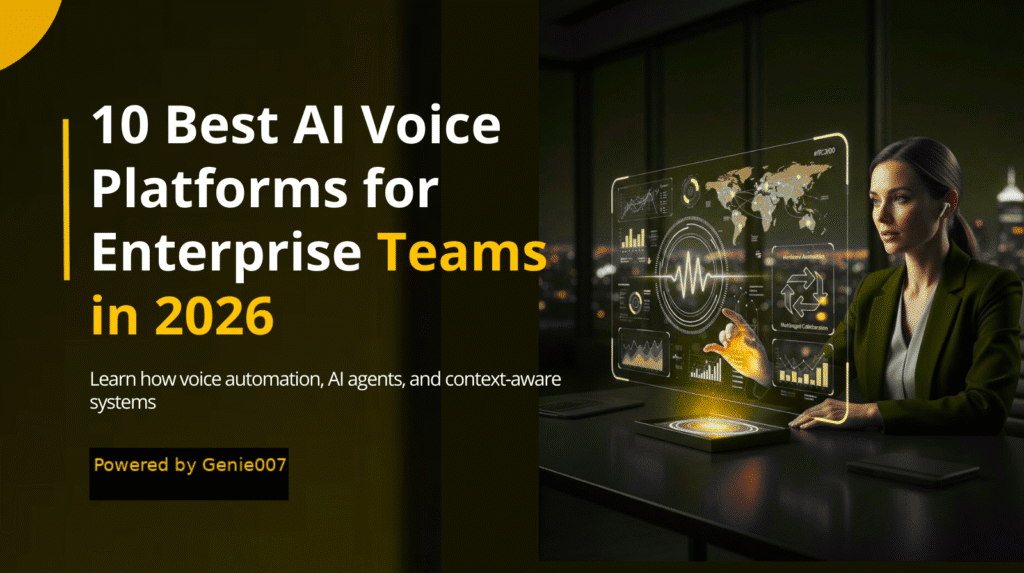
Enterprise technology in 2026 is undergoing a major transformation. Voice AI is no longer a simple speech-to-text tool or a basic assistant that answers questions. It has become a core layer of business intelligence, automation, and real-time decision-making. Today’s leading organizations are building voice-driven workflows that connect people, systems, and data in ways traditional software cannot achieve.
From healthcare and finance to logistics and global operations, enterprise teams are investing heavily in AI voice platforms because the business value is clear. These solutions reduce operational costs, improve productivity, enable faster decisions, and create seamless experiences for both employees and customers.
However, choosing the right enterprise voice platform can be challenging. With many vendors claiming innovation and superiority, leaders must understand what truly separates enterprise-grade systems from consumer tools. This guide explores the most powerful AI voice platforms for enterprise teams in 2026 and highlights the trends shaping the future of intelligent work.
Why Enterprise Voice AI Adoption Is Accelerating
Global organizations are facing pressure to do more with fewer resources. Rising costs, fragmented workflows, and increasing competition require new ways of operating. Traditional digital transformation initiatives are no longer enough. Enterprises now need intelligent systems that automate work, reduce friction, and provide instant access to insights.
Companies such as Microsoft, Google, and Amazon are embedding voice and AI into every layer of enterprise infrastructure. This shift is driven by three critical challenges.
First, operational costs continue to rise. Manual processes and repetitive tasks consume valuable resources while delivering limited strategic value. Second, enterprise workflows have become fragmented. The average organization uses more than one hundred SaaS applications, forcing employees to switch constantly between tools. Third, decision-making speed has become a competitive advantage. Leaders need real-time insights rather than delayed reports.
What is Voice AI : it solves these challenges by enabling natural communication with complex systems. Instead of navigating dashboards, professionals can ask questions, trigger workflows, and access insights instantly. Automation becomes conversational, reducing training time and improving efficiency.
Organizations deploying enterprise voice solutions are seeing measurable impact. Many report significant reductions in routine work, faster task completion, improved customer satisfaction, and stronger global collaboration.
What Makes an AI Voice Platform Enterprise-Ready
Not all voice platforms are designed for enterprise environments. Consumer assistants may perform well in simple tasks, but enterprise deployments require advanced capabilities.
Scalability and Reliability
Enterprise systems must operate continuously and handle large volumes of interactions without downtime. High availability, global infrastructure, and automatic scaling are essential.
Security and Compliance
Voice interactions often involve sensitive data. Enterprise platforms must support encryption, identity management, and compliance with regulations such as GDPR and industry-specific standards.
Context Awareness
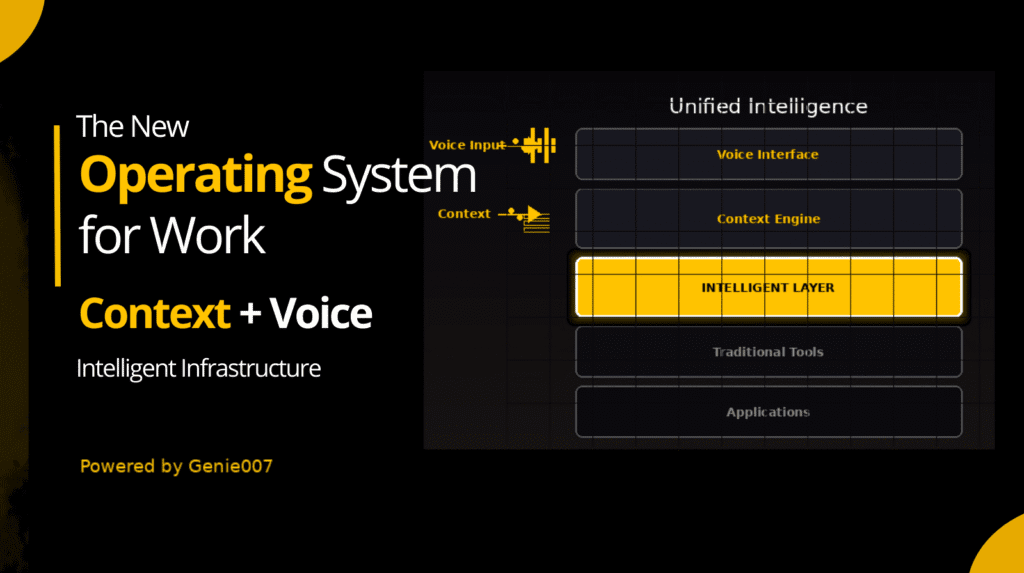
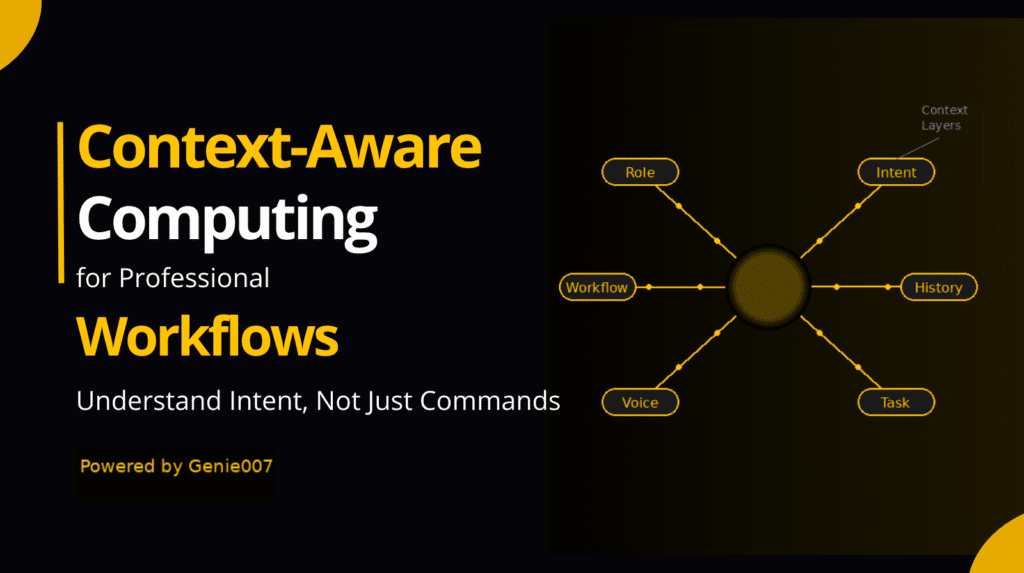
Modern voice AI must understand user identity, role, history, and current tasks. Context enables intelligent, personalized interactions and reduces errors.
Integration with Enterprise Systems
The real value of voice comes from orchestrating workflows across CRM, ERP, and collaboration tools. Deep integration ensures automation rather than isolated conversations.
Workflow Automation
Enterprise platforms should not only respond to commands but execute complex processes autonomously. This includes approvals, data updates, notifications, and cross-system coordination.
Multilingual Support
Global teams require accurate language recognition and translation. Advanced platforms enable seamless collaboration across regions.
Analytics and Insights
Data from voice interactions helps organizations optimize processes and measure return on investment.
Best AI Voice Platforms for Enterprise Teams in 2026
1. Genie 007 – Context-Driven Workflow Intelligence

Genie 007 is emerging as a next-generation enterprise intelligence platform focused on automation and orchestration rather than simple conversation.
Unlike traditional assistants, Genie 007 is designed around context awareness. It understands user roles, workflows, and business processes. This enables proactive support and autonomous execution of tasks.
The platform integrates deeply with enterprise systems and coordinates workflows across departments. Instead of answering questions, Genie 007 can trigger multi-step processes, assign responsibilities, and monitor outcomes. This approach transforms voice into a strategic productivity layer.
Organizations use Genie 007 to automate project management, customer communication, reporting, and operational workflows. The platform supports multilingual environments and global teams, making it ideal for companies seeking digital transformation at scale.
2. Microsoft Azure AI Speech
Microsoft Azure offers one of the most established enterprise voice ecosystems. It benefits from Microsoft’s global infrastructure and integration with productivity tools such as Microsoft 365.
Azure provides high reliability, advanced language models, and strong security compliance. Organizations can train custom models to improve accuracy in specialized industries. This platform is particularly effective for companies already invested in the Microsoft ecosystem.
3. Google Cloud Speech-to-Text
Google Cloud is known for advanced AI research and high recognition accuracy. The platform supports real-time and batch processing, speaker identification, and natural language understanding.
It is widely used for transcription, call analysis, and large-scale voice data processing. Continuous model improvements make it attractive for enterprises focused on innovation and accuracy.
4. Amazon Alexa for Business
Amazon Alexa extends consumer voice technology into workplace environments. It focuses on meeting management, smart office automation, and productivity.
Organizations use Alexa to control conference rooms, manage schedules, and automate workplace services. While powerful for office environments, it is less focused on deep workflow orchestration.
5. Voiceflow
Voiceflow enables teams to design and deploy conversational experiences through a visual interface. It supports collaboration between designers, developers, and business stakeholders.
This platform is ideal for customer engagement and rapid development of voice and chat experiences.
6. Cognigy
Cognigy specializes in complex customer automation and omnichannel orchestration. It offers strong context management, analytics, and integration capabilities.
Large enterprises use Cognigy to automate customer service and support interactions at scale.
7. IBM Watson Speech to Text
IBM Watson emphasizes security and compliance. It is widely adopted in regulated industries such as healthcare and financial services.
Hybrid deployment options and strong governance make it suitable for organizations with strict requirements.
8. Nuance Communications
Nuance Communications is a leader in healthcare documentation and specialized dictation. Its domain-specific models provide high accuracy for medical and legal workflows.
The platform helps professionals reduce administrative work and improve documentation quality.
9. Speechmatics
Speechmatics focuses on multilingual accuracy and real-time processing. It supports global organizations requiring reliable language recognition across diverse environments.
10. Deepgram
Deepgram is a developer-focused platform known for speed and customization. It enables organizations to build advanced voice features into products and services.
Key Trends Shaping Enterprise Voice AI
AI Agents and Autonomous Work
Voice AI is evolving into intelligent agents that understand goals rather than commands. These systems adapt, learn, and execute complex workflows.
Context as the New Interface
Context-aware voice is becoming the primary way professionals interact with systems. Instead of searching and navigating, users receive proactive insights.
Autonomous Operations
Future platforms will detect issues, predict needs, and act independently. Human intervention will be required only for strategic decisions.
Multimodal Experiences
Voice will combine with visual and text interfaces to create seamless experiences.
Real-Time Processing
Edge computing and distributed infrastructure will enable faster responses and improved privacy.
How to Choose the Right Platform
Organizations should evaluate platforms based on business goals, existing technology, and long-term strategy. Key considerations include:
- Integration with current systems
- Scalability and security
- Automation capabilities
- Multilingual support
- Vendor reliability
- Total cost of ownership
- Innovation roadmap
A clear implementation strategy and stakeholder alignment are essential for success.
The Future of Enterprise Voice AI
Voice AI is becoming a foundational layer of enterprise infrastructure. It will transform how teams collaborate, make decisions, and execute work. Platforms that combine context, automation, and intelligence will lead this transformation.
Your privacy matters. Genie 007 processes all audio locally on your device — no recordings are stored, no data is sent to external servers. For full details, see our security and privacy page.
Forward-thinking organizations are already shifting from traditional interfaces to conversational workflows. As technology continues to evolve, the gap between companies that adopt intelligent automation and those that do not will widen.
Genie 007 represents this next phase of enterprise innovation. By focusing on context awareness, workflow orchestration, and autonomous execution, it positions voice as a strategic asset rather than a simple tool.
The enterprises that invest today will build faster, more agile, and more intelligent operations for the future.
What is an AI voice platform for enterprise teams?
An AI voice platform is a software solution that enables businesses to automate communication, workflows, and task execution using voice commands and intelligent assistants. These platforms integrate with business systems to improve productivity, reduce manual work, and support global collaboration.
How do enterprise AI voice assistants improve productivity?
Enterprise AI voice assistants automate repetitive tasks such as scheduling, reporting, customer interaction, and data entry. By reducing manual processes, teams can focus on strategic work, leading to faster operations and improved efficiency.
What features should enterprises look for in AI voice platforms?
Key features include:
Context-aware intelligence
Workflow automation
Integration with CRM and business tools
Multilingual communication
Security and compliance
Scalability
Real-time decision support
Are AI voice platforms secure for business use?
Yes. Modern enterprise platforms use encryption, access control, and compliance frameworks such as GDPR and SOC2. Security is a core component for organizations handling sensitive data.
How do AI voice platforms integrate with existing business tools?
They connect with systems like CRM, ERP, project management tools, and communication platforms through APIs and cloud-based integrations. This ensures seamless automation across business operations.
What is the difference between voice AI and chatbots?
Voice AI provides natural spoken interaction, enabling hands-free workflows and real-time automation. Chatbots rely on text-based communication and are limited in real-time operational execution.
Frequently Asked Questions
How does voice typing compare to keyboard typing?
Most people type at 30-40 WPM but speak at 130-150 WPM. Voice typing with Genie 007 is 3-4x faster with 99.5% accuracy.
Does Genie 007 work on any website?
Yes. Any text field — Gmail, Slack, Notion, LinkedIn, GitHub, Google Docs, and hundreds more.
Is voice dictation private?
Genie 007 processes all audio locally. No recordings stored or sent externally. GDPR compliant, HIPAA ready.
Ready to Try Voice-to-Action?
Install Genie 007 free — no credit card required. Works on any website, any text field.
Install Genie 007 Free →Written by Bill Kiani, founder of Genie 007.