
The Misunderstood Problem Behind Professional Writing
AI workflow for writing is becoming more important than writing skills in modern professional work. Every day, professionals write emails, LinkedIn posts, reports, documentation, proposals, comments, and messages. Many of them believe their biggest weakness is writing speed or writing quality. They think they need to improve grammar, vocabulary, or sentence structure to communicate better at work.
But this belief hides the real problem.
Most professionals already know what they want to say. The idea is clear in their mind within seconds. What consumes time and energy is not thinking. It is converting that idea into a properly written format that fits the platform they are using.
The real issue is not writing skill. The real issue is manual drafting.
What an AI Workflow for Writing Actually Means in Daily Work
AI tools have made writing easier, but they have not removed the effort of writing from daily work. Professionals still open chatbots, write prompts, generate drafts, copy the output, paste it into their email or document, and then spend time editing and formatting.
This creates a new kind of workload: AI-assisted manual writing.
Even with AI, the workflow still looks like this:
- Think what to say
- Open AI tool
- Write prompt
- Copy output
- Paste into workspace
- Edit for tone and clarity
This process still depends heavily on drafting, formatting, and editing. AI improves the quality of text, but it does not remove the work required to produce it.
The Gap Between Ideas and Written Communication
Professionals rarely struggle with ideas. A manager knows how to reply to a client. A marketer knows what to post on LinkedIn. A developer knows how to explain code changes. A business owner knows what to say in follow-up emails.
The difficulty lies in converting those ideas into structured communication repeatedly throughout the day.
This gap between idea and execution is where most time is lost.
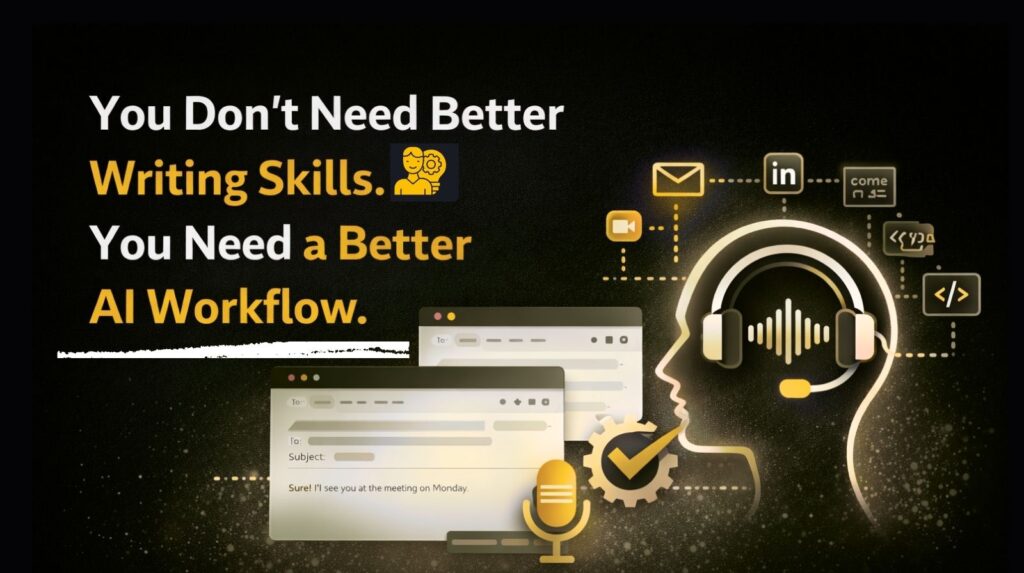
You do not need better writing skills. You need a system that removes the need to write manually.
The Hidden Cost of Manual Drafting
Manual drafting feels small in the moment, but it accumulates across the day.
A few minutes spent drafting emails. A few minutes rewriting posts. A few minutes editing AI outputs. A few minutes adjusting tone and format.
These small efforts add up to hours every week spent on mechanical writing work rather than meaningful decision-making and communication.
This is the productivity loss most professionals never measure.
Why AI Tools Alone Don’t Solve This Problem
Most AI tools are designed to generate text. They do not understand where you are working or what platform you are using. They require prompts and manual transfer of content into your workflow.
Because of this, professionals still perform several steps after AI generates the text:
- Adjusting tone for email or LinkedIn
- Formatting for the platform
- Removing unnecessary lines
- Editing the structure
The tool helps, but the responsibility of drafting still remains with the user.
Introducing the Concept of an AI Workflow
The real shift happens when you stop thinking about AI as a writing tool and start thinking about AI as part of your workflow.
An AI workflow means you do not focus on sentences. You focus on intent.
Instead of writing what you want to say, you instruct what you want to achieve.
For example, instead of drafting a reply, you simply say:
“Reply professionally and confirm the meeting for Monday.”
There is no manual drafting. No editing. No copy-paste. The task is completed where you are already working.
How AI Agents Change Professional Writing

This is where context-aware AI agents change the experience completely. They operate inside websites, understand the environment, and perform tasks directly in input fields.
One example of this approach is Genie007.
Rather than acting like a chatbot or dictation tool, this browser AI agent allows professionals to speak instructions and have the content created directly inside Gmail, LinkedIn, documents, CRMs, and other platforms.
The professional no longer writes. They instruct.
Real Situations Where This Makes a Difference
Consider how often writing appears in daily work:
Email Replies
Instead of typing responses repeatedly, you instruct the AI to respond appropriately. The reply is prepared instantly in the correct tone.
LinkedIn Posts and Messages
You share your idea, and the post is structured directly where you are writing without needing a separate AI tool.
Documentation and Notes
In editors and dashboards, the AI understands that the writing must be technical and structured.
Forms and CRM Updates
Short, clear, professional entries are created without manual drafting.
In all these cases, the need for writing skill becomes secondary. The workflow does the heavy lifting.
The Difference Between Writing and Instructing
This is the fundamental change professionals experience.
Old Method
- Think
- Write sentences
- Edit
- Format
New Method
- Think
- Instruct
- Review and send
When you remove drafting from the process, communication becomes faster and more natural.
Why This Matters for the Future of Work
As work becomes more digital and browser-based, the amount of writing professionals do every day continues to increase. Emails, posts, reports, chats, comments, and documentation fill the day.
Improving writing skill does not scale. Improving workflow does. This is where an AI workflow for writing changes everything. Instead of thinking about sentences, formatting, and drafting, professionals can focus only on intent while the AI handles the execution of communication.
AI workflows powered by context-aware AI agents represent the future where professionals spend time deciding what to say, not figuring out how to write it.
Key Takeaways
- The real problem is not writing skill but manual drafting
- AI tools still require editing and copy-paste work
- AI workflows remove the need to write sentences manually
- Context-aware AI agents complete tasks inside your workspace
- Professionals shift from writing to instructing
Conclusion: Better Workflow, Not Better Writing
For years, professionals believed they needed to become better writers to communicate effectively at work. But modern AI is revealing a different truth.
You do not need to spend time improving how you write emails, posts, and messages. You need a system that removes the need to write them manually.
AI agents like Genie007 demonstrate how a better AI workflow allows professionals to move from idea to execution without drafting, formatting, or editing.
The future of professional communication is not about writing better.
It is about not writing at all.
FAQs
Do I need strong writing skills to use AI effectively?
No. With the right AI workflow, you only need to express intent. The AI handles the writing.
Why don’t AI tools fully solve writing effort?
Because they generate text but still require manual editing, formatting, and copy-paste.
What is an AI workflow?
It is a way of working where AI completes tasks directly inside your workspace based on your instructions.
How does Genie007 support this workflow?
Genie007 works inside websites and turns spoken instructions into completed written actions.
Is this useful only for emails?
No. It applies to posts, documentation, forms, messages, and any web-based writing