
Modern workplaces overflow with sophisticated digital tools, yet professionals spend more time managing software than accomplishing actual work. Employees navigate a complex maze of dashboards, CRM systems, support panels, knowledge bases, documentation libraries, email clients, messaging platforms, and project management tools-often switching between these systems dozens of times daily.
While individual applications have become faster and more feature-rich, the overall workflow experience has paradoxically become more fragmented, disjointed, and frustrating. Workers waste valuable time searching for information, repeating data entry, explaining context to different systems, and manually orchestrating tasks across disconnected platforms.
This is where context-aware computing is fundamentally changing the rules of enterprise productivity.
Instead of waiting for users to manually guide systems through every single step, context-aware AI proactively understands who the user is, what they’re attempting to accomplish, where they are in the workflow process, what information they need, and what actions should happen next-all without requiring explicit instructions for every interaction.
This technological shift represents more than incremental improvement. It’s a complete reimagining of how professional workflows operate across enterprises, educational institutions, healthcare systems, and service organizations.
Context is no longer a luxury feature in enterprise computing. It has become the essential foundation of modern productivity.
The Critical Problem with Traditional Digital Workflows
User asks → System responds
User clicks → System loads
User searches → System displays results
User inputs data → System processes
What Traditional Systems Fail to Understand
Despite their apparent sophistication, conventional enterprise systems remain fundamentally context-blind. They don’t comprehend or utilize:
User Role and Organizational Position: Whether the person is an executive, manager, employee, contractor, customer, or student-and what information and actions should be available based on that role.
Current Task and Objective: What the user is actually trying to accomplish within the larger business process or workflow.
Interaction History and Continuity: Previous conversations, completed transactions, ongoing issues, or established preferences that provide essential context for the current interaction.
Urgency and Priority Signals: Whether this is a routine inquiry or a time-sensitive issue requiring immediate attention.
Broader Workflow Context: How this specific action fits into a larger business process involving multiple steps and potentially multiple systems.
Communication Preferences: Language preference, preferred contact methods, accessibility requirements, or interaction style.
The Productivity Cost of Context-Blind Systems
Because traditional systems lack contextual awareness, professionals waste enormous amounts of time performing low-value activities:
- Repeating identical information across multiple systems and interactions
- Navigating complex menu structures to find features they use regularly
- Performing redundant verification steps that systems should remember
- Explaining context repeatedly to different tools, departments, or support agents
- Manually transferring data between disconnected applications
- Searching for information the system should proactively surface
- Clarifying intent when natural language should be sufficient
Research indicates that information workers spend 19% of their time searching for information and an additional 8% attempting to track down colleagues who can help them find information. That’s more than a full day per week lost to activities intelligent systems could automate.
This isn’t fundamentally a technology limitation anymore. Modern hardware, networks, and databases are perfectly capable of supporting intelligent workflows. It’s a context limitation. Systems possess the raw computing power but lack the contextual intelligence to use it effectively.
Understanding Context-Aware Computing: Definition and Core Principles
Context-aware computing refers to intelligent systems capable of collecting, interpreting, and actively utilizing situational information to provide relevant, personalized, and proactive responses-without requiring users to explicitly provide instructions or context for every single interaction.
The Multiple Dimensions of Context
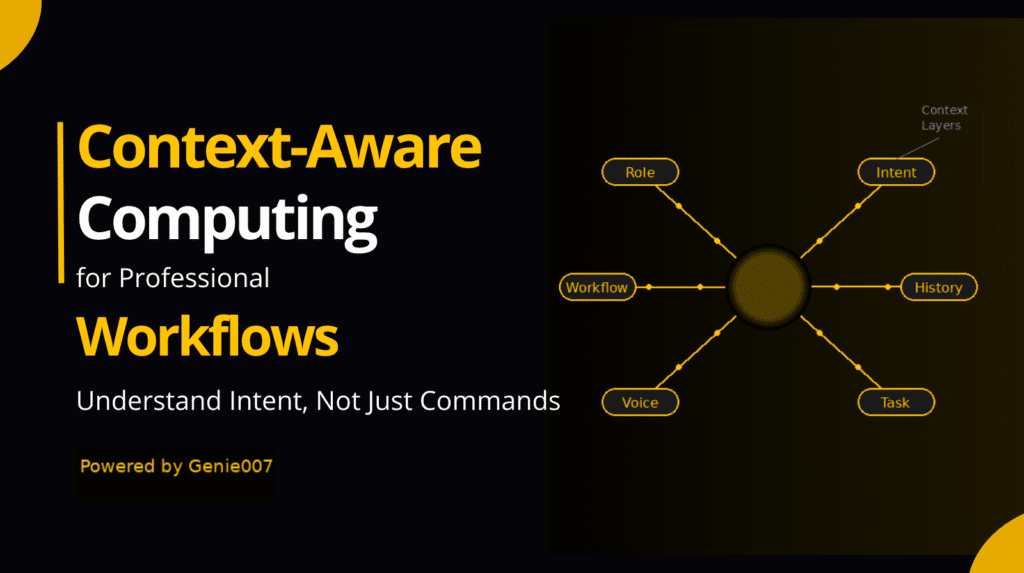
Comprehensive context awareness encompasses several interconnected dimensions:
1. Identity and Role Context
- User identity (who is interacting with the system)
- Organizational role and responsibilities
- Access permissions and security clearance
- Department, team, or functional area
- Seniority level and decision-making authority
2. Historical and Interaction Context
- Previous conversations and support tickets
- Completed transactions and activities
- Established preferences and customizations
- Ongoing issues or open processes
- Behavioral patterns and typical workflows
3. Current Task and Intent Context
- What page or application section the user is viewing
- What they were doing immediately before the current action
- Inferred goal or objective based on behavior
- Stage of completion within a multi-step process
- Related tasks or dependencies
4. Environmental and Situational Context
- Physical location (office, remote, field)
- Device type (desktop, mobile, tablet, kiosk)
- Network conditions and connectivity
- Time of day, day of week, and seasonal factors
- External events affecting operations
5. Workflow and Process Context
- Position within larger business process
- Dependencies on other systems or people
- Approval chains and governance requirements
- Service level agreements and deadlines
- Compliance and documentation needs
6. Communication and Preference Context
- Preferred language and regional settings
- Communication style and formality level
- Accessibility requirements or accommodations
- Notification preferences and contact methods
- Learning style and experience level
The Fundamental Shift: From Questions to Understanding
Traditional systems constantly ask: “What do you want?”
Context-aware systems proactively understand: “What you’re likely trying to achieve-and how I can help you accomplish it efficiently.”
This seemingly subtle difference creates profound changes in how professional environments operate. Systems transform from passive tools requiring constant instruction into intelligent assistants that anticipate needs and guide users toward successful outcomes.
Why Context Awareness Revolutionizes Professional Workflows
Professional work rarely consists of isolated, independent tasks. Instead, activities exist as interconnected components of larger, more complex processes:
A customer support ticket represents one touchpoint within an ongoing customer relationship and journey-not an isolated problem to solve.
A student’s enrollment question is part of their entire academic lifecycle from application through graduation-not just a single administrative inquiry.
A purchase requisition request exists within a broader procurement workflow involving budget approval, vendor selection, contract negotiation, and payment processing=not merely a form to complete.
A patient’s appointment scheduling request connects to their complete healthcare process including diagnosis, treatment plans, test results, and ongoing care coordination-not simply a calendar entry.
The Context Continuity Advantage
Without context awareness: Systems treat every interaction as completely new, requiring users to re-establish context, explain their situation, provide identifying information, and navigate to appropriate functions from scratch each time.
With context awareness: Systems recognize interactions as continuations of ongoing relationships and processes, automatically applying relevant historical information, current status, and logical next steps without requiring users to repeat or explain.
This contextual continuity drastically reduces friction, eliminates redundancy, and accelerates task completion. More importantly, it fundamentally shifts the relationship between users and systems.
From Users Guiding Systems to Systems Guiding Users
In traditional workflows, professionals must guide systems:
- Navigate to the correct application or module
- Find the appropriate form or function
- Fill in required fields with information the system should know
- Click through confirmation screens
- Verify results and handle exceptions manually
With context-aware computing, systems guide professionals:
- Proactively surface relevant information based on current task
- Suggest logical next actions within the workflow
- Pre-populate known information automatically
- Handle routine steps autonomously
- Alert users only when decisions or exceptions require human judgment
This inversion transforms productivity. Instead of professionals spending cognitive energy managing software, they focus exclusively on work requiring human expertise, judgment, and creativity.
From Command Execution to Intent Understanding: The AI Evolution
Traditional enterprise systems operate on command-response patterns, requiring precise keywords, menu selections, or form completions to trigger specific functions. Users must learn the system’s language and structure.
Context-aware systems operate on intent recognition, understanding what users actually want to accomplish regardless of how they express it. Systems learn users’ natural communication patterns.
Real-World Intent Recognition Example
Consider a seemingly simple user request:
User statement: “I need help with my enrollment.”
Traditional system response: Display a generic search results page showing dozens of articles about enrollment procedures, deadlines, requirements, and policies. The user must read through results, identify relevant information, and piece together what they need to do.
Context-aware system understanding:
- User is a newly admitted student (not current student or prospective applicant)
- They’re currently viewing the admissions portal welcome page
- They previously uploaded required documents three days ago
- Enrollment deadline for their program is in 5 days
- Their account profile indicates Urdu as preferred language
- They haven’t completed the enrollment confirmation step yet
Context-aware system response: “I see you’ve submitted your admission documents. To complete your enrollment for the Fall 2026 semester, you need to: 1) Confirm your course selections (deadline in 5 days), 2) Submit your fee payment, and 3) Complete the orientation registration. Would you like me to guide you through confirming your courses now?” (Response provided in Urdu if preferred)
The Difference Between Automation and Intelligence
The enrollment example illustrates a crucial distinction:
Automation executes predefined scripts based on specific triggers. If user input doesn’t match expected patterns, automation breaks down or provides irrelevant responses.
Intelligence understands underlying intent even when expressed in varied ways, applies contextual knowledge to determine appropriate responses, and adapts based on specific situations rather than following rigid scripts.
Context-aware computing enables true intelligence in enterprise systems, moving beyond simple automation to genuine understanding and adaptive assistance.
How Context-Aware Computing Eliminates Redundant Work

| Redundant Activity | Typical Time Cost | Context-Aware Solution |
|---|---|---|
| Asking for user identification and details | 1-3 minutes per interaction | System recognizes user automatically |
| Verifying account or customer information | 2-5 minutes per support ticket | Context provides instant verification |
| Understanding the specific issue or request | 3-8 minutes of back-and-forth clarification | Intent recognition from natural language |
| Routing to appropriate department or specialist | 5-15 minutes including wait time | Context determines correct routing instantly |
| Explaining standard processes repeatedly | 10-20 minutes of staff time daily | Automated guidance based on user context |
| Searching for relevant information across systems | 15-30% of work time weekly | Proactive information surfacing |
The Compounding Effect of Context Awareness
When implemented comprehensively, context-aware computing can reduce redundant interactions by 60-80% across many professional workflows. This isn’t just efficiency improvement-it’s workflow transformation.
The AI-powered system already knows:
- Who is interacting with the system (identity, role, permissions)
- What they’ve done previously (history, preferences, ongoing issues)
- What they’re trying to accomplish (inferred intent based on behavior and stated goals)
- What should happen next (logical workflow progression and available actions)
This comprehensive contextual understanding eliminates the vast majority of clarifying questions, verification steps, navigation searches, and manual routing decisions that consume professional time without creating value.
The Critical Role of Voice in Context-Aware Professional Systems
Voice interaction adds a transformational dimension to context-aware computing, creating capabilities impossible with traditional text-based interfaces.
Why Voice Amplifies Context Awareness
Natural Language Richness: When users speak naturally rather than typing keywords, they provide significantly richer information. Spoken language includes context clues, qualifiers, urgency indicators, and nuanced meaning that keyword searches miss.
Tone and Emotion Detection: Voice carries emotional and urgency signals through tone, pace, and emphasis. Context-aware systems can detect frustration requiring immediate escalation versus routine inquiries.
Faster Intent Capture: Speaking is 3-4 times faster than typing for most users. Voice enables users to express complex requests in seconds that would require minutes to type accurately.
Hands-Free and Eyes-Free Operation: Voice allows interaction while users remain focused on other tasks-reviewing documents, operating equipment, or navigating physical spaces.
Accessibility and Inclusion: Voice removes barriers for users with varying typing abilities, visual impairments, or situations where keyboard/screen interaction is impractical.
Voice + Context = Intelligent Workflow Execution
The combination of voice interaction and contextual awareness creates unprecedented workflow capabilities:
Instant Intent Recognition: Users speak naturally, and context-aware systems immediately understand specific requests within the broader workflow context.
Relevant Data Access: Systems automatically retrieve user-specific, role-appropriate information without requiring navigation or search.
Multi-Step Action Execution: Complex workflows involving multiple systems execute through simple voice commands rather than tedious manual processes.
Conversational Clarification: When additional information is needed, systems engage in natural dialogue rather than presenting confusing forms or error messages.
Continuous Context Building: Each voice interaction adds to the user’s contextual profile, making future interactions progressively more efficient and personalized.
Enterprise Voice AI Adoption
This is precisely why leading enterprises are combining voice AI technology with context-aware computing to fundamentally redesign professional workflows. The synergy between these technologies creates capabilities neither could deliver independently.
Context-Aware Computing in Action: Professional Environment Examples
The abstract benefits of context awareness become concrete when examining specific professional applications:
Customer Support and Service Operations
Traditional Approach:
- Customer contacts support and waits in queue
- Agent asks for account information and identification
- Customer explains their issue from scratch
- Agent searches through account history to understand context
- Agent asks clarifying questions
- If needed, issue gets transferred to specialist (customer repeats everything)
- Agent provides solution or escalates further
Context-Aware Approach:
- System recognizes customer immediately upon contact
- AI reviews complete account history, recent interactions, and service status automatically
- System infers likely issue based on current context (recent order, open tickets, service alerts)
- Customer states issue briefly in natural language
- System provides targeted solution immediately or routes to appropriate specialist with full context
- All information transfers seamlessly-no repetition required
Impact: Average handling time reduced 40-60%, customer satisfaction increased 25-40%, agent productivity improved significantly as they handle only complex cases requiring human expertise.
Educational Institution Platforms
Student Request Example: “When is my next exam?”
Traditional System: Returns exam schedule page showing all exams for all programs. Student must find their specific program, identify their courses, and locate relevant exam dates manually.
Context-Aware System Understands:
- Student’s specific academic program and current semester
- Courses currently enrolled in
- Previous exam history and performance patterns
- Any pending academic tasks or requirements
- Preferred communication language
- Student’s typical access patterns and interaction style
Context-Aware Response: “Your next exam is Organic Chemistry on March 15th at 2:00 PM in Hall B. You also have Biology on March 18th. Would you like me to send you study resources or connect you with the study group?” (Provided in student’s preferred language)
Impact: Student gets precise answer instantly, reducing administrative staff workload by 70%+ for routine inquiries while improving student satisfaction and engagement.
Healthcare Systems and Patient Services
Patient Request Example: “I need to see my test results.”
Traditional System Challenges:
- Patient must log into portal
- Navigate to test results section
- Find correct results among potentially many historical tests
- May not understand medical terminology
- Unclear what results mean or what actions are needed
Context-Aware Healthcare System Knows:
- Patient’s recent medical visits and ordered tests
- Which test results are newly available
- Attending physician and care team
- Scheduled follow-up appointments
- Patient’s medical history and conditions
- Health literacy level and communication preferences
Context-Aware Response: “Your blood work results from last Tuesday are available. Your glucose levels are normal, and cholesterol has improved since your last test. Dr. Smith will discuss detailed results during your appointment next Friday. Would you like me to send a summary to your email or schedule an earlier consultation if you have questions?”
Impact: Reduced administrative call volume 50-70%, improved patient satisfaction and engagement, decreased staff time spent on routine inquiries, better care coordination.
Enterprise Websites and Employee Portals
Common Employee Scenario: Accessing company resources, submitting requests, or getting information about policies and procedures.
Traditional Portal Experience:
- Employee searches through complex menu structures
- Navigates to HR, IT, or operations sections
- Fills out forms with information already in company systems
- Submits request and waits for response
- May need to follow up or clarify through separate channels
Context-Aware Voice Assistant on Portal:
- Recognizes employee role, department, and location automatically
- Understands common requests for that role and context
- Guides users through processes conversationally
- Executes routine actions autonomously
- Pre-populates known information automatically
- Routes complex requests with full context to appropriate teams
Example Interaction:
Employee: “I need to request time off for next month.”
Context-Aware System: “I can help you with that vacation request. Based on your accrual, you have 12 days available. Your team calendar shows the week of March 20-24 has no major deadlines. Would you like to request those dates? I’ll route approval to your manager Sarah automatically.”
Impact: 60-80% reduction in HR and IT support tickets, faster request processing, improved employee experience, significant time savings across organization.
Context-Aware Computing Enables True Workflow Automation
When context awareness combines with AI workflow automation capabilities, systems evolve from providing assistance to executing complete processes autonomously.
From Answering Questions to Taking Actions
Traditional systems stop at information provision. Context-aware systems complete tasks.
Example Workflow: Invoice Request
User Voice Command: “I need my last invoice.”
Context-Aware System Actions:
- Identifies user from voice authentication and session context
- Determines “last invoice” means most recent billing document for user’s account
- Accesses billing system with appropriate permissions
- Retrieves correct invoice document
- Sends invoice via user’s preferred delivery method (email automatically detected from profile)
- Logs interaction for audit and future reference
- Asks if additional assistance needed
User Experience: Entire process completed in seconds through single voice command. No navigation, no searching, no forms, no waiting.
Complex Multi-System Workflow Example
Scenario: Employee expense report submission
Traditional Process:
- Open expense management system
- Create new expense report
- Enter trip details, dates, purpose
- Upload receipts individually
- Categorize each expense
- Enter amounts and currency conversions
- Submit for approval workflow
- Wait for manager approval
- Follow up if questions arise
Context-Aware Automated Process:
Employee: “Submit my expenses from the Chicago conference.”
System actions automatically:
- Identifies Chicago conference from calendar (dates, purpose, approval already on record)
- Retrieves hotel receipt from email (automatically forwarded by hotel)
- Imports flight costs from corporate travel system
- Pulls meal expenses from corporate card transactions
- Categorizes expenses based on company policy
- Applies correct currency conversions
- Routes to manager for approval with conference context attached
- Notifies employee of submission and estimated reimbursement timeline
Employee saves 30-45 minutes. Finance team processes faster with complete, accurate information. Manager approves with full context.
This is the transformative power of context-aware workflow automation-turning complex, multi-step manual processes into simple voice commands executed intelligently by systems that understand complete context.
How Genie007 Implements Enterprise Context-Aware Computing
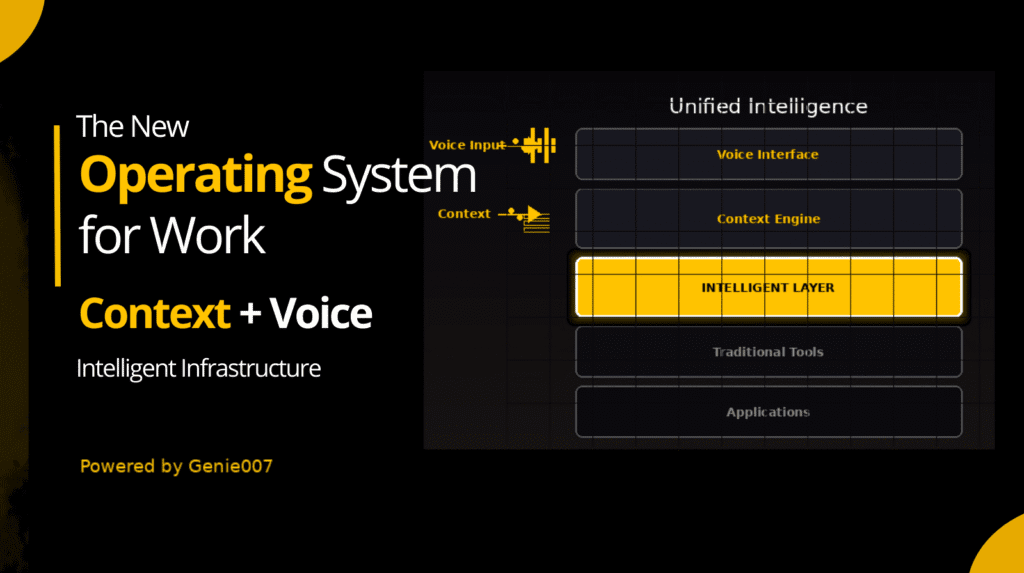
Genie007 is architected from the ground up on the principle that professional interactions should never exist as isolated, context-free events. Instead, every interaction is understood as part of ongoing relationships, workflows, and processes.
Genie007’s Context-Aware Architecture
Voice-First Natural Interaction: Users communicate naturally through voice or text without learning specific commands or navigating complex interfaces. The system understands intent from natural language.
Comprehensive Multilingual Understanding: Support for 140+ languages with automatic detection and real-time processing, ensuring global teams and diverse user bases interact in their preferred languages without barriers.
Dynamic Role and Permission Awareness: Automatic recognition of user roles, organizational positions, and access permissions-ensuring appropriate information and actions are available based on identity and authority.
Deep Workflow Integration: Native understanding of enterprise business processes, task dependencies, approval chains, and multi-system workflows-enabling intelligent guidance and autonomous execution.
Real-Time Contextual Processing: Continuous analysis of user behavior, interaction patterns, current tasks, and environmental factors to build and apply comprehensive contextual models.
Learning and Adaptation: Machine learning systems that improve understanding and performance based on interaction outcomes, user feedback, and changing organizational patterns.
How Genie007 Understands Complete Context
When a user interacts with Genie007, the system immediately comprehends:
Identity Context: Who the user is, their role, department, permissions, and relationship to the organization.
Location Context: Where they are on the website, which application or portal section, what they were viewing immediately before interaction.
Activity Context: What task they’re performing, what stage of a workflow they’ve reached, what they’ve completed previously.
Intent Context: What they’re trying to accomplish based on stated goals and inferred objectives from behavior patterns.
Historical Context: Previous interactions, completed transactions, ongoing issues, established preferences, and relationship history.
Next Action Context: Logical workflow progression, available actions based on current state, dependencies, and requirements.
Context-Aware Digital Assistant, Not Just Chatbot
This comprehensive contextual understanding enables Genie007 to function as an intelligent digital assistant embedded directly into professional workflows-not merely a question-answering chatbot operating in isolation.
Genie007 doesn’t just respond to queries. It proactively guides users through processes, executes routine tasks autonomously, surfaces relevant information without being asked, and serves as an intelligent intermediary between professionals and complex enterprise systems.
Measurable Organizational Benefits of Context-Aware Systems
Organizations implementing comprehensive context-aware computing report quantifiable improvements across multiple operational dimensions:
| Business Metric | Typical Improvement | Contributing Factors |
|---|---|---|
| Support and Service Workload | 60-80% reduction | Automated handling of routine requests, context eliminates clarification time |
| Average Task Completion Time | 40-70% faster | Eliminated navigation, pre-populated information, intelligent guidance |
| User and Employee Satisfaction | 25-50% increase | Frictionless experience, instant assistance, personalized interaction |
| Training Requirements | 50-70% reduction | Systems guide users naturally, less need for formal training on tools |
| Operational Efficiency | Significant gains | Staff focus on high-value work, reduced redundant activities |
| Data Quality and Utilization | Substantial improvement | Automated capture, reduced manual entry errors, insights from interaction patterns |
| Cross-System Integration | Seamless workflows | Context spans multiple systems, eliminating manual data transfer |
| Scalability | Handle 5-10x volume | Automated workflows don’t require proportional staff increases |
Strategic Advantages Beyond Efficiency
While operational improvements are significant, context-aware computing delivers strategic benefits that extend far beyond cost reduction:
Competitive Differentiation: Organizations providing superior user experiences through intelligent, context-aware systems differentiate themselves in markets where traditional competitors offer frustrating, friction-filled interactions.
Innovation Enablement: When employees spend dramatically less time on routine tasks and system navigation, they redirect energy toward innovation, strategic initiatives, and activities that genuinely advance organizational objectives.
Knowledge Preservation: Critical organizational knowledge embedded in context-aware systems survives turnover, ensuring operational continuity despite workforce changes.
Adaptive Capability: Context-aware systems that learn and evolve can adapt to changing business conditions, new processes, and emerging needs without requiring extensive reprogramming.
Global Reach: Multilingual context-aware systems enable seamless support for international operations without requiring separate infrastructure or staff for each region.
The Fundamental Shift: From Interface-Centric to User-Centric Computing
Context-aware computing represents a profound philosophical shift in enterprise technology design and deployment.
The Traditional Paradigm: Users Adapt to Systems
Conventional enterprise software operates on an interface-centric model where:
- Users must learn specific interfaces, menu structures, and navigation patterns
- Professionals adapt their workflows to match system capabilities and limitations
- Each application requires separate training and creates separate work patterns
- Users serve the software’s needs (data entry, process compliance) rather than software serving user needs
- Efficiency depends on user expertise in manipulating tools
This model asks the fundamental question: “How do I use this system?”
The Context-Aware Paradigm: Systems Adapt to Users
Context-aware computing inverts this relationship into a user-centric model where:
- Systems learn user patterns, preferences, and natural communication styles
- Technology adapts workflows to match how users naturally work
- Consistent intelligent assistance spans all applications and processes
- Software serves user objectives and removes obstacles to productivity
- Efficiency depends on system intelligence rather than user training
This model asks a completely different question: “What do I need to accomplish?”
The system handles the rest-determining how to execute tasks, which systems to access, what information to retrieve, and what actions to perform.
The Human-Technology Partnership
This shift doesn’t eliminate the need for human expertise, judgment, and creativity. Instead, it optimizes the partnership between human intelligence and computational capability:
Humans focus on:
- Strategic decisions requiring judgment and experience
- Creative problem-solving and innovation
- Relationship building and emotional intelligence
- Complex situations requiring nuanced understanding
- Activities that genuinely benefit from human capabilities
Context-aware systems handle:
- Routine information retrieval and processing
- Multi-system workflow coordination
- Data entry, verification, and validation
- Pattern recognition and automated decision-making for standard scenarios
- Activities that benefit from computational speed and consistency
This optimized division of labor maximizes both human potential and technological capability.
Why Context-Aware Computing Has Become Essential for Modern Enterprises
As organizations grow and business environments become more complex, the imperative for context-aware computing intensifies.
The Complexity Challenge
Enterprise complexity manifests in multiple dimensions:
Tool Proliferation: Organizations deploy dozens or hundreds of specialized applications. Employees must navigate this fragmented landscape daily.
Data Volume: Information generated and stored grows exponentially, making manual search and retrieval increasingly ineffective.
Process Sophistication: Business workflows span multiple systems, teams, and often geographic regions-requiring coordination beyond human capacity to manage manually.
Regulatory Requirements: Compliance obligations demand comprehensive documentation, audit trails, and process consistency that manual systems struggle to maintain.
Global Operations: International business requires multilingual communication, regional adaptation, and 24/7 availability impossible to deliver through traditional staffing.
The Context-Aware Solution
Without context awareness: Growing complexity directly increases workload, training requirements, error rates, and operational costs proportionally.
With context awareness: Intelligent systems manage complexity transparently, presenting users with simplified, personalized experiences regardless of underlying system sophistication.
Context-aware computing transforms complexity from a burden into an asset, enabling systems to leverage rich data and sophisticated capabilities while protecting users from overwhelming detail.
From Experimental to Essential
Context-aware computing is no longer an experimental emerging technology or optional enhancement. It has become essential infrastructure for modern digital operations, as fundamental as databases, networks, or security systems.
Organizations without context-aware capabilities increasingly find themselves at decisive competitive disadvantages in:
- Operational efficiency and cost structure
- User and employee experience quality
- Ability to scale operations without proportional cost increases
- Speed of task completion and decision-making
- Innovation capacity as teams spend time on routine work
- Global reach and multilingual capability
The Future of Professional Workflows: Voice, Context, and Intelligence
The trajectory of professional work environments is clear. Within the next 3-5 years, how professionals interact with enterprise systems will look fundamentally different from today.
The Emerging Interaction Model
Professionals will spend dramatically less time:
- Searching through menus and navigation structures
- Clicking through multi-step processes
- Typing repetitive information into forms
- Manually coordinating activities across systems
- Waiting for responses to routine requests
Instead, they will primarily:
- Speak natural requests and commands
- Ask questions in their own words
- Confirm recommended actions
- Review automated results
- Focus on work requiring human judgment
The Intelligent Intermediary Layer
Context-aware AI will function as an intelligent intermediary layer sitting between users and enterprise systems, serving several critical roles:
Intent Translator: Converting natural human communication into precise system actions across multiple applications.
Context Manager: Maintaining comprehensive situational awareness spanning user identity, history, current tasks, and workflow state.
Workflow Orchestrator: Coordinating complex multi-step processes across different systems without requiring user intervention.
Information Synthesizer: Gathering relevant data from multiple sources and presenting consolidated, actionable insights.
Proactive Assistant: Anticipating needs, surfacing relevant information before being asked, and suggesting optimal actions based on context.
The Productivity Revolution
This transformation won’t merely make existing workflows more efficient. It will fundamentally redefine what “productivity” means in professional environments:
From: How quickly can professionals complete routine tasks?
To: How much routine work can be eliminated entirely?
From: How well can employees learn and use enterprise systems?
To: How effectively can systems understand and serve employee needs?
From: How many staff members are required for operational workload?
To: How intelligently can systems handle routine operations autonomously?
Frequently Asked Questions About Context-Aware Computing
What is context-aware computing in professional environments?
Context-aware computing refers to intelligent systems that collect, interpret, and utilize situational information-including user role, interaction history, current task, environmental factors, and workflow state-to provide relevant, personalized responses and actions without requiring users to explicitly provide context for every interaction.
How does context-aware computing improve professional workflows?
Context-aware systems dramatically improve workflows by: eliminating repetitive data entry and verification steps, understanding user intent from natural language, providing personalized guidance based on role and situation, executing routine tasks autonomously, and enabling seamless coordination across multiple systems-typically reducing task completion time by 40-70% and workload by 60-80%.
Why is voice interaction important in context-aware systems?
Voice interaction is critical because it: enables faster, more natural communication than typing, captures richer contextual signals including tone and urgency, allows hands-free and eyes-free operation, removes accessibility barriers, and provides 3-4x faster input than keyboard-based interaction-significantly amplifying the benefits of contextual understanding.
What is the difference between automation and context-aware intelligence?
Traditional automation executes predefined scripts based on specific triggers and exact input patterns. Context-aware intelligence understands underlying user intent even when expressed differently, applies situational knowledge to determine appropriate responses, adapts to specific circumstances, and learns from interactions to improve over time-moving beyond rigid automation to genuine adaptive intelligence.
How does Genie007 implement context-aware computing?
Genie007 implements comprehensive context awareness through: voice-first natural language interaction supporting 140+ languages, dynamic role and permission recognition, deep workflow integration across enterprise systems, real-time contextual processing of user behavior and intent, continuous learning from interaction patterns, and intelligent orchestration of multi-system processes-functioning as a context-aware digital assistant rather than a simple chatbot.
What business results can organizations expect from context-aware systems?
Organizations typically achieve: 60-80% reduction in support workload, 40-70% faster task completion, 25-50% improvement in user satisfaction, 50-70% reduction in training requirements, significant operational efficiency gains, improved data quality and utilization, seamless cross-system integration, and ability to handle 5-10x interaction volume without proportional staff increases.
How long does it take to implement context-aware computing in an enterprise?
Implementation timelines vary based on scope and complexity. Basic context-aware AI assistants handling common workflows can be deployed in 4-8 weeks. Comprehensive enterprise implementations with deep system integration, extensive workflow coverage, and custom context models typically require 2-4 months. Most organizations start with high-impact use cases and expand systematically.
Do employees need technical training to use context-aware systems?
One of the primary advantages of context-aware computing is minimal training requirements. Because systems understand natural language, adapt to user patterns, and provide intelligent guidance, employees can interact effectively with little to no formal training. The system learns the user rather than requiring the user to learn the system-dramatically reducing onboarding time and ongoing training needs.
Is context-aware computing secure for handling sensitive enterprise data?
Context-aware systems are designed with enterprise security as a core requirement, including: role-based access control ensuring users only access permitted information, encrypted data transmission and storage, comprehensive audit trails of all interactions, compliance with industry regulations (GDPR, HIPAA, etc.), and security policies that apply contextual rules based on user identity, location, and data sensitivity. Properly implemented, context-aware systems actually improve security by enforcing consistent access policies and maintaining detailed activity logs.