

The Silent Productivity Killer No One Measures
For most digital businesses, productivity loss doesn’t come from big system failures or missed deadlines. It comes from something far more subtle – copy-paste work.
Every day, professionals copy text from emails, documents, websites, spreadsheets, and AI tools, then paste it somewhere else. It feels harmless. It feels fast. And because it’s so familiar, it’s almost invisible.
But in 2026, as businesses race toward automation and AI-driven efficiency, copy-paste workflows have quietly become one of the largest hidden drains on time, focus, and output quality.
This article breaks down:
- How much time copy-paste work actually steals
- Why it damages productivity more than most teams realize
- And how modern browser-native AI tools like Genie007 eliminate this problem entirely
The Modern Copy-Paste Workflow: A Daily Reality
Let’s look at a typical knowledge worker’s day.
They:
- Read an email → copy details → paste into a reply
- Open a website → copy information → paste into a document
- Ask an AI chatbot → copy output → paste into LinkedIn or Gmail
- Switch tabs repeatedly between tools, platforms, and windows
This behavior happens dozens or even hundreds of times per day.
What used to be a convenience has turned into a dependency.
And that dependency has a cost.
The Real Cost of Copy-Paste: Time, Focus, and Mental Energy
1. Copy-Paste Isn’t Just a Physical Action – It’s Cognitive Work
Each copy-paste action involves:
- Visual scanning
- Decision-making (what to copy, what to ignore)
- Context switching between tabs
- Refocusing on the new task
According to cognitive science research on context switching, even small interruptions can cost 20–30 seconds of mental refocus time.
Multiply that by 100+ copy-paste actions per day.
That’s not seconds anymore.
That’s hours.
2. The Numbers: How Much Time Is Actually Lost?
Conservatively speaking:
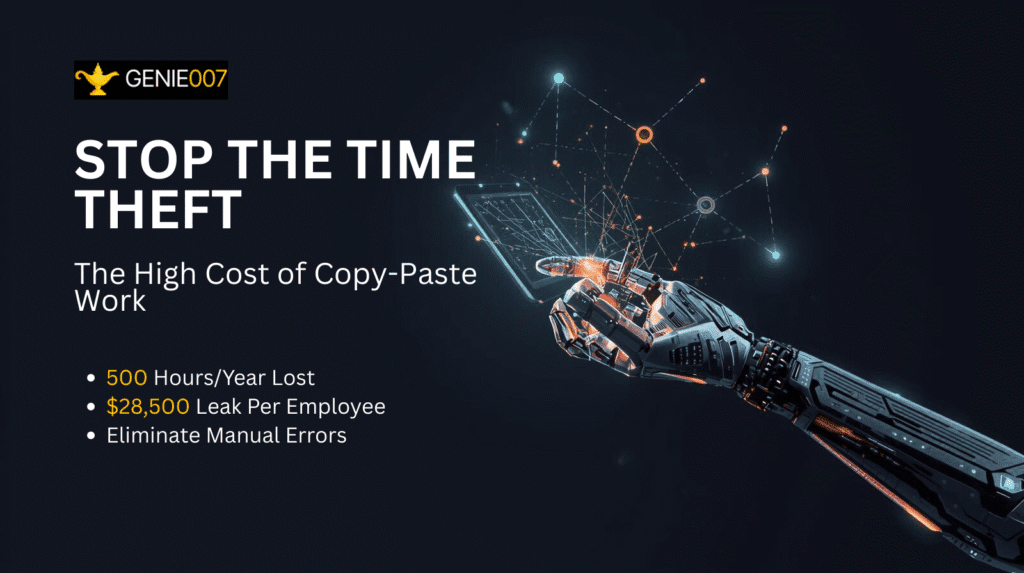
- Average professional performs 80–120 copy-paste actions per day
- Each action costs 15–30 seconds including refocus
- That equals 20–60 minutes per day
- Over a year, that’s 200–250 hours per employee
For a team of just 10 people, that’s 2,000+ hours lost annually – the equivalent of one full-time employee doing nothing but copying and pasting.
Why Copy-Paste Errors Cost Businesses More Than Time
Human Error Is Built Into Manual Transfer
Copy-paste workflows introduce errors that are difficult to detect:
- Wrong names in emails
- Incorrect prices or figures
- Missing context when pasting AI responses
- Broken formatting
- Partial or outdated information
These errors don’t just look unprofessional – they damage trust, slow down projects, and create rework that compounds over time.
The Brand Impact No One Talks About
Clients don’t see your workflow — they see the result.
A pasted response that feels generic, mismatched, or context-blind:
- Reduces perceived professionalism
- Makes communication feel automated in the wrong way
- Weakens brand voice consistency
Ironically, copy-pasting AI output often makes work feel less human, not more.
Why Traditional AI Tools Didn’t Fix the Problem
When AI chatbots became popular, many teams thought copy-paste would disappear.
Instead, it got worse.
Why?
Because most AI tools are still destination-based:
- You leave your work
- Go to a separate AI window
- Describe your context manually
- Copy the response
- Paste it back into your original task
This adds even more steps, not fewer.
AI helped generate content — but it did not remove friction.
The Shift in 2026: From Copy-Paste to Browser-Native AI
This is where the real transformation begins.
In 2026, productivity leaders are moving away from copy-paste workflows toward browser-native AI assistants.
Instead of forcing humans to move data between tools, the AI works directly inside the browser, where the work already happens.
What Is Browser-Native AI (And Why It Changes Everything)?
A browser-native AI assistant like Genie007:
- Lives inside your browser as an extension
- Understands the page you are currently on
- Reads context automatically
- Executes actions instead of just generating text
You don’t copy information to the AI.
The AI already sees it.
How Genie007 Eliminates Copy-Paste Work Completely
1. Voice-to-Action Instead of Copy-Paste
With Genie007, you don’t:
- Copy text
- Switch tabs
- Paste output
You simply speak.
For example:
“Reply to this email professionally and ask for a meeting on Friday.”
Genie007:
- Reads the email
- Understands tone and context
- Drafts the reply directly in Gmail
- Ready to send – no paste required
2. Context Awareness Across Any Website
Genie007 adapts automatically based on where you are:
- On LinkedIn → professional social tone
- In a code editor → documentation or “vibe coding”
- In a CMS → blog-ready formatting
- On a form → structured, accurate input
This removes the need to explain context – which is one of the biggest reasons copy-paste still exists.
3. Multilingual Work Without Copying Between Translators
For global teams, copy-paste is often tied to translation.
Genie007 supports 140+ languages, allowing users to:
- Speak in one language
- Generate native-level output in another
- Input it directly into the active website
No translation tabs.
No pasted text.
No formatting loss.
The Productivity Impact: What Businesses Actually Gain
When copy-paste is removed, businesses see measurable improvements:
- 1.5–2 hours saved per employee per day
- Faster response times across email and social media
- Fewer communication errors
- Reduced mental fatigue
- Improved consistency in brand voice
Over a year, this compounds into massive operational leverage.
Privacy Matters: Why Browser-Native AI Is Safer
Another hidden issue with copy-paste workflows is data exposure.
Each paste into a third-party tool risks:
- Sensitive data leakage
- Uncontrolled cloud storage
- Compliance violations
Genie007 processes much of its data locally within the browser, following a privacy-first, sovereign AI approach.
Your data stays where your work happens — not on external servers used to train unknown models.
The Future of Work: No More “Draft → Copy → Paste → Fix”
The traditional workflow:
Research → Draft → Copy → Paste → Edit → Send
Is disappearing.
With browser-native AI:
Intent → Voice → Execution
This is not just faster – it’s structurally better.
It aligns human thinking with machine execution, instead of forcing humans to act as the middleman.
Conclusion: Copy-Paste Is Manual Labor in Disguise
Copy-paste feels digital, but it’s still manual labor.
In 2026, businesses that still rely on it are operating below their potential — not because they lack talent, but because their tools are outdated.
The companies that win are the ones that:
- Remove friction
- Reduce cognitive load
- Let AI act, not just suggest
By adopting a browser-native AI assistant like Genie007, you don’t just save time – you change how work gets done.
The end of copy-paste isn’t about convenience.
It’s about working at the speed of thought.