
Every modern enterprise generates an overwhelming tsunami of data every single day. This isn’t structured analytics data or carefully curated business intelligence-it’s the raw, unprocessed stream of digital interactions that flows continuously through your organization’s systems.
Customer support chats logged and forgotten. Support tickets resolved and archived. Thousands of emails sent and received. Website search queries that lead nowhere. Call center conversations recorded but never analyzed. Internal employee questions answered repeatedly. System logs that capture every user click, every navigation path, every moment of hesitation.
Most of this data is never used productively.
It simply becomes what industry experts call “digital exhaust“-information created as an inevitable byproduct of daily business operations but never transformed into actionable intelligence or operational value.
The fundamental challenge facing modern enterprises isn’t data scarcity. Organizations are drowning in data. The real problem is the systemic inability to convert digital exhaust into actionable workflows that measurably improve productivity, dramatically reduce workload, and create genuinely superior customer and employee experiences.
This article explores how a revolutionary new layer of enterprise intelligence is emerging: AI agents powered by context-aware Voice AI, systematically transforming everyday interactions into meaningful automated actions that redefine what productivity means in the modern workplace.
Understanding Digital Exhaust in the Enterprise Context
Digital exhaust represents the massive volume of unused, unanalyzed data continuously generated during regular business operations. Unlike traditional business analytics focused on deliberate data collection, digital exhaust consists of the ambient information created simply by running your business day-to-day.
Common Sources of Enterprise Digital Exhaust
Customer-Facing Interactions:
- Repeated customer questions appearing across website chat widgets
- Common support queries flooding email inboxes and chat systems
- Frequently asked questions in social media comments
- Repetitive call center conversations covering identical topics
- Product inquiry patterns revealing customer confusion points
Internal Employee Operations:
- Frequently asked internal questions by employees seeking policy clarification
- Repeated IT support requests for common technical issues
- Recurring HR inquiries about benefits, procedures, and documentation
- Standard operational questions asked across departments daily
System and Behavioral Data:
- Website and application navigation patterns showing user confusion
- Search query logs revealing what users cannot find easily
- Click-through patterns indicating workflow bottlenecks
- Abandoned transaction data highlighting process friction
- User session recordings capturing struggle points
The Paradox of Data Abundance
Individually, each support chat, each employee question, each navigation click seems minor and inconsequential. But collectively, when analyzed across hundreds or thousands of interactions, these data points reveal powerful patterns about what people need repeatedly, where processes fail consistently, and which workflows create unnecessary friction.
Yet despite sitting on this goldmine of operational insight, most companies systematically ignore digital exhaust. Why? Because traditional enterprise systems lack the intelligence infrastructure to capture, analyze, and act on these patterns in real-time.
The Hidden Opportunity Inside Repetitive Interactions

When your analytics show that hundreds or thousands of users ask the same questions, follow identical navigation paths, or contact support for the same issues, this pattern isn’t just interesting data-a flashing signal indicating concrete business opportunities:
This repetitive process can be automated. If 500 customers weekly ask “Where is my order?”, this represents 500 opportunities for instant automation rather than human-handled support tickets.
This information can be delivered proactively. If employees constantly search for the same policy documents, intelligent systems can surface this information automatically based on role and context.
This interaction can be handled without any human effort. If call centers handle thousands of password reset requests monthly, AI agents can execute these workflows autonomously through voice interaction.
Why Most Organizations Miss This Opportunity
The tragedy is that despite generating massive volumes of digital exhaust daily, most enterprises fail to capture and utilize this opportunity effectively. The data exists, the patterns are clear, but the transformation never happens.
Why? Because traditional enterprise systems are fundamentally not designed to learn from interaction patterns in real-time and autonomously create workflows based on observed needs.
Why Traditional Systems Cannot Convert Data into Workflows
Most enterprises continue relying on legacy approaches that react to problems without evolving from them:
Static FAQ Pages and Knowledge Bases
Traditional FAQ sections require users to search manually, navigate complex category structures, and hope the right answer exists. They don’t adapt to user behavior, don’t learn from search patterns, and don’t proactively surface information based on context.
Rule-Based Chatbots
First-generation chatbots operate on predetermined decision trees and keyword matching. They cannot understand natural language nuance, cannot comprehend user intent beyond scripted scenarios, and frustrate users when conversations deviate from programmed paths.
Manual Helpdesk Teams
Human support teams answer the same questions repeatedly without systematic automation. Knowledge exists in individual heads rather than intelligent systems, and scaling requires adding more people rather than smarter technology.
Standard Operating Procedures (SOPs)
Written procedures document processes but don’t execute them. Employees must find, read, interpret, and manually follow documented steps-creating friction, inconsistency, and wasted time.
Critical Limitations of Traditional Systems
These legacy approaches share fundamental limitations preventing them from transforming digital exhaust into actionable workflows:
No Understanding of User Intent: They react to literal keywords without comprehending what users actually need or what problem they’re trying to solve.
No Contextual Awareness: They cannot adapt responses based on who the user is, what role they hold, which system they’re using, or what they were doing immediately before the interaction.
No Language Adaptability: They typically operate in single languages, creating barriers for global teams and multilingual customer bases.
No Pattern Recognition: They don’t learn from repetitive interactions, identify emerging trends, or automatically optimize based on observed user behavior.
No Workflow Execution: They provide information but cannot execute actions, complete tasks, or orchestrate multi-step processes autonomously.
As a result, the same customer queries continue flooding support channels. The same employee questions get asked repeatedly. The same operational workload persists quarter after quarter. And productivity remains artificially limited by manual, repetitive work that intelligent systems should handle automatically.
The Fundamental Shift: From Information Storage to Intelligent Action
Leading enterprises are now undergoing a fundamental paradigm shift-moving from simply storing and organizing data to actively transforming it into intelligent, automated action.
This transformation represents more than incremental improvement. It’s a complete reconceptualization of how organizations should handle the constant stream of interactions flowing through their systems.
The New Enterprise Intelligence Model
Instead of allowing valuable interactions to dissipate as wasted digital exhaust, forward-thinking companies are deploying AI agents that systematically:
Detect Repetitive Patterns Automatically: Advanced machine learning algorithms continuously analyze interaction data across all channels, identifying questions, requests, and processes that occur repeatedly with statistical significance.
Understand What Users and Employees Frequently Need: Natural language processing (NLP) systems comprehend the underlying intent behind questions and requests, grouping functionally similar interactions even when phrased differently.
Convert Identified Needs into Automated Workflows: Intelligent systems automatically create and deploy workflows that handle common requests without human intervention, from simple information delivery to complex multi-step processes.
Deliver Responses Through Natural Voice Interaction: Modern AI agents enable users to speak naturally rather than navigate menus, click through pages, or type queries-dramatically reducing friction and improving user experience.
This comprehensive approach creates a self-improving system where every interaction potentially contributes to better automation, and workflows continuously optimize based on real-world usage patterns.
How AI Agents Transform Digital Exhaust into Actionable Workflows
Modern AI agents operate on a fundamentally different paradigm than traditional automation. They don’t just execute predefined scripts-they observe organizational behavior, learn from patterns, and autonomously act to improve operations.
The Three-Phase Transformation Process
Phase 1: Observation and Pattern Recognition
AI agents continuously monitor interactions across all enterprise touchpoints, building comprehensive behavioral models that reveal:
- 60% of customer support questions cluster around 10-15 common topics
- Employees ask the same internal policy questions daily across departments
- Website visitors consistently struggle with identical navigation challenges
- Multilingual users face predictable communication barriers
- Specific user segments encounter recurring friction points
Phase 2: Intent Understanding and Workflow Design
Advanced natural language understanding (NLU) systems analyze why users ask questions or seek help, comprehending:
- The underlying problem users are trying to solve
- The business process they’re attempting to complete
- The information they need to make decisions
- The actions they want systems to execute on their behalf
Based on this deep intent analysis, AI agents automatically design workflows that address root needs rather than surface symptoms.
Phase 3: Automated Execution and Continuous Optimization
Once workflows are established, AI agents:
- Handle requests autonomously through voice and text interfaces
- Execute multi-step processes without human involvement
- Provide personalized responses based on user context and role
- Communicate in users’ preferred languages automatically
- Continuously refine responses based on effectiveness metrics
Real-World Enterprise Transformation Example
Consider a mid-sized enterprise with global operations facing overwhelming support volume.
Before AI Agent Implementation:
The support organization employed 15 full-time agents handling approximately 2,000 tickets weekly. Analysis revealed:
- “How do I reset my password?” appeared in 18% of tickets
- “Where is my order?” represented 22% of inquiries
- “How do I schedule an appointment?” accounted for 15% of requests
- Product configuration questions consumed 25% of support time
- General policy inquiries filled the remaining 20%
Support agents answered these functionally identical questions hundreds of times weekly, creating massive inefficiency. Customer wait times averaged 12 minutes. Support costs exceeded $1.2M annually.
After AI Agent Implementation:
The organization deployed a voice-enabled AI agent accessible on their website, mobile app, and phone system. Results after 90 days:
- 75% of routine queries handled automatically by the AI agent without any human involvement
- Multilingual voice support deployed in 8 languages covering 95% of customer base
- Response time reduced to instant for automated interactions
- Support staff workload decreased 70%, enabling focus on complex cases requiring human judgment and empathy
- Customer satisfaction scores increased 35% due to immediate resolution
- Annual cost savings projected at $850K through reduced staffing requirements and increased efficiency
The digital exhaust-those thousands of repetitive support questions-transformed into automated workflows delivering measurable business value.
The Critical Role of Voice in Workflow Automation
Voice interaction represents far more than a convenience feature. It’s a fundamental reimagining of how humans should interact with enterprise systems, removing layers of friction that have existed since the beginning of computing.
Why Voice Transforms Digital Exhaust Utilization
Eliminates Navigation Friction: Users no longer search through menus, navigate category hierarchies, or hunt for the right form. They simply speak their intent naturally.
Captures Intent More Accurately: Natural spoken language reveals user intent more clearly than typed keywords or menu selections, enabling AI agents to understand and respond appropriately.
Delivers Solutions Immediately: Voice enables real-time conversation where AI agents clarify requirements, gather necessary information, and execute workflows in a single fluid interaction.
Guides Users Through Complex Processes: For multi-step workflows, voice provides step-by-step guidance naturally, similar to how a helpful colleague would assist in person.
Accommodates Diverse Users: Voice removes barriers for users with varying technical literacy, accessibility needs, or situations where hands-free interaction is preferable.
Voice as the Interface for Intelligent Automation
Voice transforms passive data collection into active, productive interaction. Instead of users leaving digital exhaust through abandoned searches or incomplete forms, they engage in successful conversations where AI agents:
- Understand what they need immediately
- Gather any required additional context through natural dialogue
- Execute appropriate workflows automatically
- Confirm completion and offer related assistance
- Learn from the interaction to improve future responses
This conversational approach means every voice interaction generates higher-quality data that contributes to better automation and more effective workflows.
Context-Aware Intelligence: The Essential Missing Layer
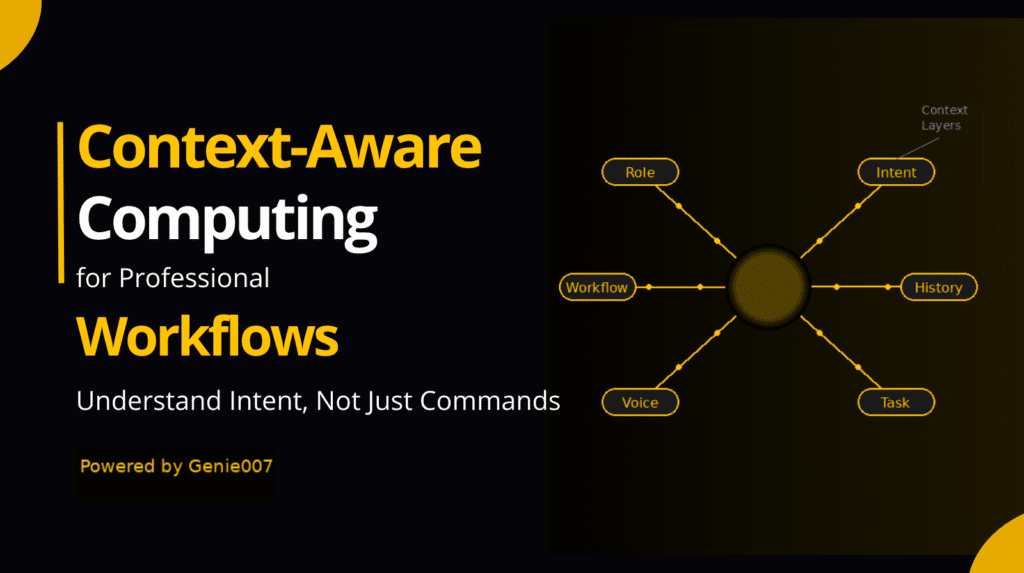
The transformational power of modern AI agents comes not just from automation or voice interaction, but from context-aware intelligence-the ability to understand the complete situation surrounding each interaction and adapt accordingly.
The Multiple Dimensions of Context
User Identity and Role: AI agents recognize whether they’re interacting with a customer, employee, manager, contractor, or system administrator-and adjust capabilities, information access, and response style accordingly.
Intent and Objective: Advanced systems comprehend what users are trying to accomplish, not just what they’re literally saying. “I need to travel to New York next week” might require flight booking, hotel reservation, expense policy information, or calendar management depending on additional context.
Language and Communication Preference: Context-aware AI automatically detects user language preference and responds appropriately, supporting seamless multilingual operations without requiring manual selection.
System and Platform Context: AI agents know which system, device, or platform users are accessing-website, mobile app, smart kiosk, phone system-and adapt interface and capabilities to match.
Historical Interaction Context: Intelligent systems remember previous conversations, completed transactions, expressed preferences, and past issues-enabling continuity across interactions.
Temporal and Situational Context: AI agents understand time-sensitive situations, business hours, regional considerations, and circumstantial factors affecting appropriate responses.
How Context Enables Truly Actionable Workflows
Context awareness transforms generic automation into personalized, accurate, and genuinely useful workflows.
Consider a simple request: “I need the quarterly report.”
Without context awareness: A traditional system might return dozens of search results for various quarterly reports, forcing the user to manually identify and download the correct document.
With context awareness: An intelligent AI agent understands:
- The user’s department and role (Sales Manager)
- Which quarter is relevant (Q4 just ended)
- Which specific report the user needs based on their role (Sales Performance Summary)
- The user’s access permissions
- Whether the report has been published yet
The AI agent immediately delivers the correct Q4 Sales Performance Summary, or if unavailable, explains when it will be published and offers to notify the user automatically.
This level of contextual intelligence transforms digital exhaust from noise into signal, creating workflows that genuinely improve productivity rather than adding another layer of technology to navigate.
How Genie007 Enables Enterprise Transformation
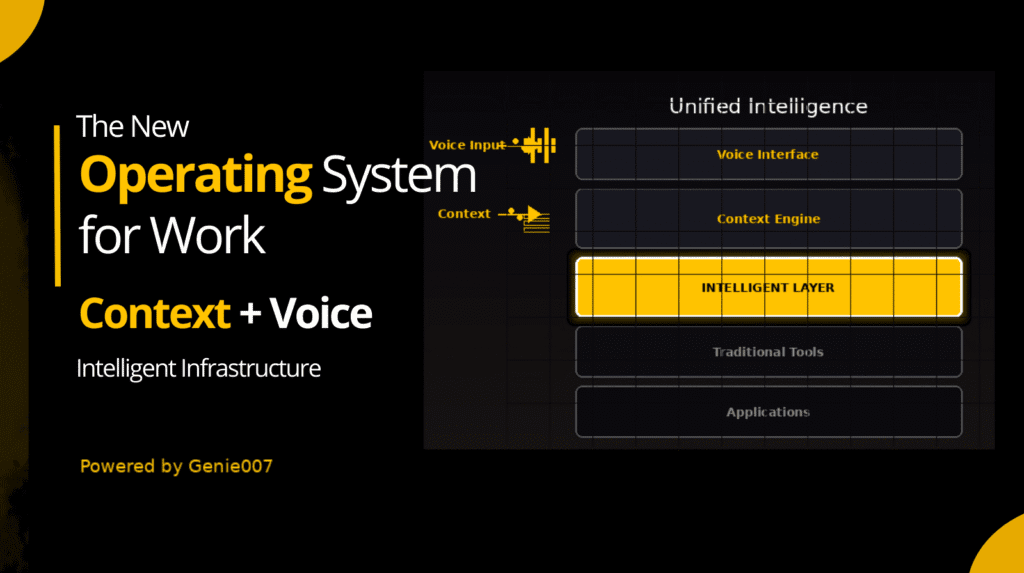
Genie007 is purpose-built to convert everyday enterprise digital interactions into intelligent, automated workflows through a comprehensive platform combining:
Core Genie007 Capabilities
Context-Aware AI Architecture: Sophisticated understanding of user identity, intent, role, situation, and historical context enabling personalized, accurate responses and actions.
Voice-First Interaction Design: Natural spoken conversation as the primary interface, removing friction and enabling users to communicate intent naturally rather than navigating complex systems.
Comprehensive Multilingual Communication: Support for 140+ languages with automatic detection and real-time translation, enabling seamless global operations without language barriers.
Role-Based Response Systems: Dynamic adaptation of available information, actions, and interface based on user role, permissions, and organizational context.
Enterprise Platform Integration: Native connectivity with existing business systems including CRM, ERP, ITSM, HRIS, and custom applications-enabling workflows that span multiple systems.
Continuous Learning and Optimization: Machine learning systems that automatically improve response quality, workflow efficiency, and user satisfaction based on interaction outcomes.
Transforming Digital Exhaust Systematically
Rather than allowing valuable interaction data to remain unused, Genie007 systematically:
- Captures every customer and employee interaction across all channels
- Analyzes patterns to identify automation opportunities
- Designs and deploys intelligent workflows automatically
- Executes workflows through natural voice and text interfaces
- Measures effectiveness and continuously optimizes performance
- Scales seamlessly as interaction volume grows
Measurable Business Impact of Converting Digital Exhaust
Transforming digital exhaust into actionable workflows delivers quantifiable business value across multiple dimensions:
| Business Area | Measurable Impact |
|---|---|
| Customer Support Workload | Reduced by 70-80% through automated handling of routine queries |
| Response Time | Instant resolution for automated workflows (from minutes or hours) |
| Employee Productivity | Significant increase as staff focus on high-value work vs. repetitive tasks |
| Customer Satisfaction | 20-40% improvement due to immediate service and 24/7 availability |
| Operational Costs | Substantial reduction through decreased dependency on manual labor |
| Scalability | Handle 10x interaction volume without proportional cost increase |
| Global Reach | Serve international customers in native languages without translation costs |
| Data Quality | Higher quality insights from structured, analyzed interactions vs. unstructured exhaust |
Beyond Cost Reduction: Strategic Advantages
While cost savings and efficiency gains are significant, the strategic advantages of converting digital exhaust extend further:
Competitive Differentiation: Organizations delivering instant, personalized service through intelligent automation create superior customer experiences that competitors relying on traditional support models cannot match.
Innovation Acceleration: Teams freed from repetitive work can focus on innovation, strategic initiatives, and activities that genuinely advance business objectives.
Operational Resilience: Automated workflows continue functioning during disruptions, holidays, and high-volume periods without degradation.
Knowledge Preservation: Critical operational knowledge lives in intelligent systems rather than individual employees, protecting organizations from knowledge loss due to turnover.
Redefining Productivity in the Modern Enterprise
The fundamental definition of productivity is evolving in modern enterprises.
Traditional productivity meant doing existing work faster-processing more tickets per hour, handling more calls per agent, completing more tasks per day.
Modern productivity means eliminating unnecessary work entirely-identifying tasks that shouldn’t require human attention and automating them completely, freeing professionals to focus exclusively on work that genuinely requires human judgment, creativity, and expertise.
The Productivity Hierarchy
Leading organizations now think about productivity in hierarchical terms:
Tier 1 – Eliminate: Identify repetitive work that AI agents can handle completely. This work should never reach humans.
Tier 2 – Augment: For complex work requiring human judgment, provide AI assistance that handles routine aspects, gathers relevant information, and enables faster, better decisions.
Tier 3 – Enable: Focus human professionals exclusively on strategic, creative, and relationship-building activities where human capabilities create irreplaceable value.
Converting digital exhaust into actionable workflows enables this hierarchical approach by systematically identifying and automating Tier 1 work, providing the foundation for enhanced productivity at all levels.
The Future of Enterprise Operations
The trajectory of enterprise operations is clear: organizations will increasingly measure operational success not by headcount, but by automation effectiveness.
Emerging Operational Metrics
Progressive enterprises are adopting new KPIs reflecting this transformation:
- Automation Rate: Percentage of interactions handled without human involvement
- Digital Exhaust Utilization: Proportion of generated data converted into actionable workflows
- Workflow Efficiency: Time and resources saved through intelligent automation
- Self-Service Success Rate: Percentage of users resolving needs independently through AI agents
- Escalation Precision: How accurately systems route complex issues to appropriate human experts
The Competitive Imperative
Businesses that adopt intelligent workflow automation early will establish decisive competitive advantages:
Speed Advantage: Operating at machine speed for routine work while competitors rely on human-paced processes.
Cost Advantage: Serving customers and supporting operations at dramatically lower cost structures.
Scale Advantage: Growing capacity without proportional increases in headcount or infrastructure.
Experience Advantage: Delivering superior customer and employee experiences through immediate, personalized service.
Organizations that delay this transformation will find themselves increasingly unable to compete on speed, cost, or experience-the three fundamental dimensions of modern business competition.
Frequently Asked Questions:
What exactly is digital exhaust in enterprise environments?
Digital exhaust refers to the massive volume of unused, unanalyzed data continuously generated during regular business operations-including customer chats, support tickets, employee queries, website searches, call center conversations, and system interaction logs. This data typically remains dormant rather than being transformed into actionable intelligence or automated workflows.
How can AI agents effectively use digital exhaust data?
AI agents analyze digital exhaust to identify patterns in user behavior and needs. By recognizing that certain questions, requests, or processes occur repeatedly, AI agents can automatically design and deploy workflows that handle these interactions without human intervention. This transforms wasted data into productivity-enhancing automation.
Why is voice interaction important for workflow automation?
Voice enables faster, more natural interaction by removing navigation friction. Users simply speak their intent rather than searching menus or typing queries. Voice also captures user intent more accurately and enables real-time conversational workflows where AI agents can clarify requirements, gather information, and execute multi-step processes fluidly.
What is context-aware AI and why does it matter?
Context-aware AI understands the complete situation surrounding each interaction-including user identity, role, intent, language preference, system being used, and historical interactions. This contextual intelligence enables personalized, accurate workflows rather than generic responses, dramatically improving automation effectiveness and user satisfaction.
How does Genie007 help enterprises transform digital exhaust?
Genie007 provides a comprehensive context-aware, multilingual Voice AI platform specifically designed to convert enterprise interactions into intelligent automation. It systematically captures interaction data, identifies patterns, designs workflows, and executes them through natural voice and text interfaces-while continuously learning and optimizing based on outcomes.
What business results can enterprises expect from implementing AI workflow automation?
Organizations typically see 70-80% reduction in support workload, instant response times for automated interactions, significant increases in employee productivity, 20-40% improvement in customer satisfaction, and substantial operational cost reductions. Beyond efficiency gains, businesses achieve strategic advantages through superior customer experience and operational scalability.
How long does it take to implement enterprise AI workflow automation?
Implementation timelines vary based on complexity and scope. Basic AI agent deployments handling common workflows can be operational within 4-8 weeks. Comprehensive enterprise implementations with deep system integration and extensive workflow coverage typically require 2-4 months. The key is starting with high-impact use cases and expanding systematically.
What skills or technical expertise do enterprises need to manage AI workflow automation?
Modern AI platforms like Genie007 are designed for business users, not just technical teams. While initial setup benefits from technical and business process expertise, ongoing management typically requires minimal technical knowledge. The platform handles complexity through intuitive interfaces, automated optimization, and continuous learning capabilities.