

Every professional sends emails daily. Some send ten. Some send fifty. But very few realize how much time is silently consumed not in thinking what to say, but in the process of writing it. Opening Gmail, clicking compose, typing, editing, rephrasing, checking tone, correcting grammar, and finally pressing send-this routine repeats dozens of times a day.
The real problem is not communication. The problem is manual drafting.
Most professionals already know what they want to say. The idea is clear in their head within seconds. Yet, converting that idea into a properly structured, professional email takes minutes every single time. Over days, weeks, and months, this adds up to hours lost in pure formatting and typing work.
This is the part of work nobody measures, yet everyone experiences.
Why Writing Emails Still Feels Slow in the AI Era
We live in a time where AI can write essays, summarize books, and generate code. Yet, when it comes to daily emails, professionals still feel stuck in the same old workflow.
You might use voice typing to speed things up. But voice typing only converts speech into raw text. You still need to correct sentences, adjust tone, and format the message.
You might use a chatbot to generate an email draft. But that means opening another tab, writing prompts, copying the output, and pasting it into your email. The process still involves manual movement and editing.
Even with AI tools, the workflow still looks like this:
Think → Type/Prompt → Edit → Copy → Paste → Send
AI has improved writing quality, but it has not removed the drafting process.
The Gap Between Idea and Execution
The most important observation in professional communication is this:
The idea takes 3–5 seconds to form.
The writing takes 2–3 minutes to complete.
This gap is where productivity is lost.
Professionals don’t struggle with ideas. They struggle with converting ideas into properly written communication across emails, LinkedIn messages, CRM notes, and reports. This is not a creativity problem. It is a workflow problem.
And this is exactly where traditional AI tools fail to help.
Introducing a New Way: From Voice to Action (Idea to Email)
A new category of AI is changing this experience entirely. Instead of helping you write faster, this approach removes writing from the process.
This is where context-aware, voice-to-action AI agents enter.
Instead of saying sentences like you would in voice typing, you simply give instructions like you would to a colleague:
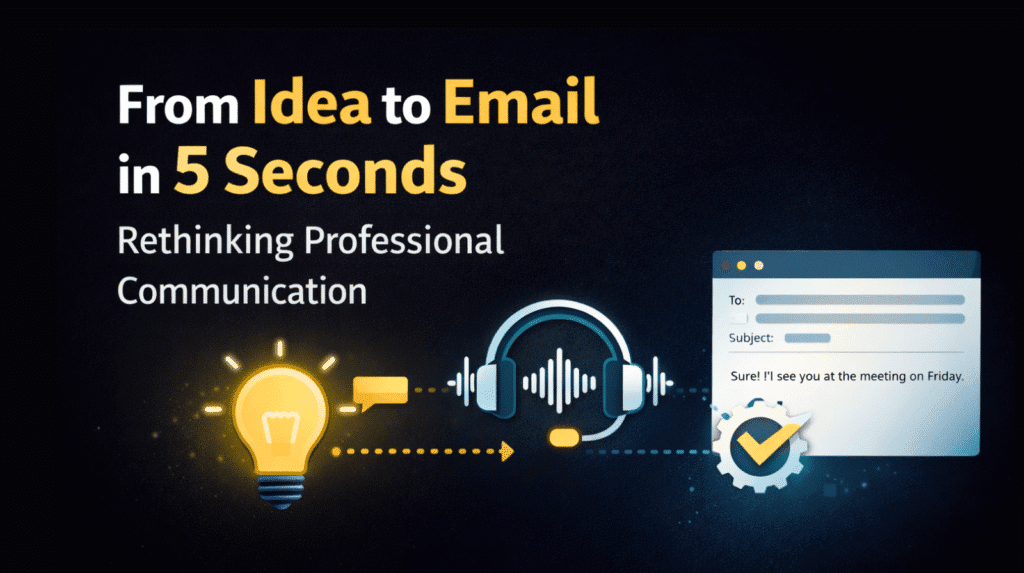
“Reply to this email and confirm the meeting for Friday in a professional tone.”
There is no drafting. No formatting. No copy-paste. The AI understands the email, understands the context, creates the reply, and places it directly into the reply box-ready to send.
The gap between idea and email disappears.
How Professional Communication Changes with AI Agents
To understand the difference, compare the old workflow with the new one.
Old Workflow
- Open email
- Think what to write
- Type or use voice typing
- Edit for tone and clarity
- Fix formatting
- Send
New Workflow with AI Agents
- Open email
- Speak your intent
- Review and send
The change is subtle but powerful. You are no longer writing emails. You are issuing instructions.
One example of this new approach is Genie007, a browser AI agent designed to work directly where professionals already work. It understands the page context, the tone required, and the intent behind your words. Instead of assisting with text, it performs the task inside your workflow.
Real Scenarios Where This Saves Hours
Consider how this applies to daily professional life.
An account manager replying to clients throughout the day no longer needs to type repetitive confirmations and updates. A content creator responding to collaboration emails can handle replies in seconds. A business owner clearing their inbox in the morning can go through dozens of emails without typing a single line.
Developers documenting updates, marketers replying to LinkedIn messages, and students emailing professors-all benefit from removing the drafting phase.
These small time savings per email turn into massive productivity gains over weeks.
The End of Manual Drafting
The core realization is this: professionals were never meant to spend time drafting repetitive communication. Drafting is mechanical work. Thinking and decision-making are valuable work.
AI agents shift professionals away from mechanical writing and toward meaningful communication.
This is often described as:
- The death of copy-paste work
- The death of manual drafting
- The rise of ambient AI inside workflows
And it signals a major shift in how communication happens in modern workplaces.
Why This Matters for the Future of Work
By 2026, professional tools will not be judged by how well they generate text, but by how well they perform actions in context. Communication will become faster, more natural, and less dependent on typing.
Voice-to-action will become standard. Professionals will speak their intent and let AI handle execution. This is particularly impactful for global teams, non-native English speakers, and anyone who deals with large volumes of daily communication.
The keyboard will no longer be the primary tool for communication. Intent will be.
Key Takeaways
- The problem in emails is not thinking-it is manual drafting
- AI tools still require editing, copy-paste, and formatting
- AI agents remove the drafting phase completely
- Voice-to-action closes the gap between idea and execution
- Professional communication becomes faster and more natural
FAQs
Why do emails still take time even with AI tools?
Because AI tools generate text but do not execute tasks inside your workflow. Editing and formatting are still required.
What is voice-to-action AI?
It allows you to speak instructions instead of sentences, and the AI performs the task directly in context.
How does this improve productivity?
By removing manual drafting, copy-paste work, and editing time from daily communication.
Is this useful only for emails?
No. It applies to LinkedIn messages, CRM notes, documentation, and any web-based communication.
How does Genie007 fit into this approach?
Genie007 is a context-aware AI agent that works directly inside websites, turning spoken instructions into completed actions.
Communication Without Typing
Professional communication has not been rethought in decades. We still type emails the same way we did years ago, even though AI has evolved dramatically.
The real breakthrough is not faster typing or better grammar correction. It is removing the need to write altogether.
Moving from idea to email in 5 seconds is no longer a concept-it is a practical reality with modern AI agents like Genie007. When professionals stop drafting and start instructing, communication becomes effortless, efficient, and aligned with how humans naturally think.
The future of professional communication is not about writing better emails.
It is about not writing them at all.