
Most professionals want to write social media posts without typing, but they struggle with the effort required to turn simple ideas into well-written posts across multiple platforms. A thought that comes naturally in your mind becomes a slow, mechanical process once you open LinkedIn, X, Instagram, or Facebook to publish it.
You begin typing. You delete lines. You adjust tone. You shorten sentences. You add hashtags. You reformat spacing. Then you repeat the same process again because each platform demands a slightly different writing style. What looked like a quick update becomes a drafting session that drains time and mental energy.
The difficulty is not creativity. The difficulty is manual drafting.
This is why many professionals avoid posting consistently, even when they know social visibility is important for personal branding, business growth, and audience engagement.
Why AI writing tools still don’t remove the workload
To solve this, many people turn to AI writing tools. They open a chatbot, write a prompt, generate a post, and then copy the result into their social platform. But this does not actually fix the workflow problem.
After generating the text, you still have to:
- Copy the content
- Paste it into LinkedIn or another platform
- Adjust the tone
- Add hashtags
- Fix formatting
- Re-edit awkward phrases
AI helped produce words, but you still performed all the steps required to convert those words into a publishable post. The manual drafting process remains.
The problem was never writing sentences.
The problem was executing posts across platforms.
The shift from typing posts to speaking intent
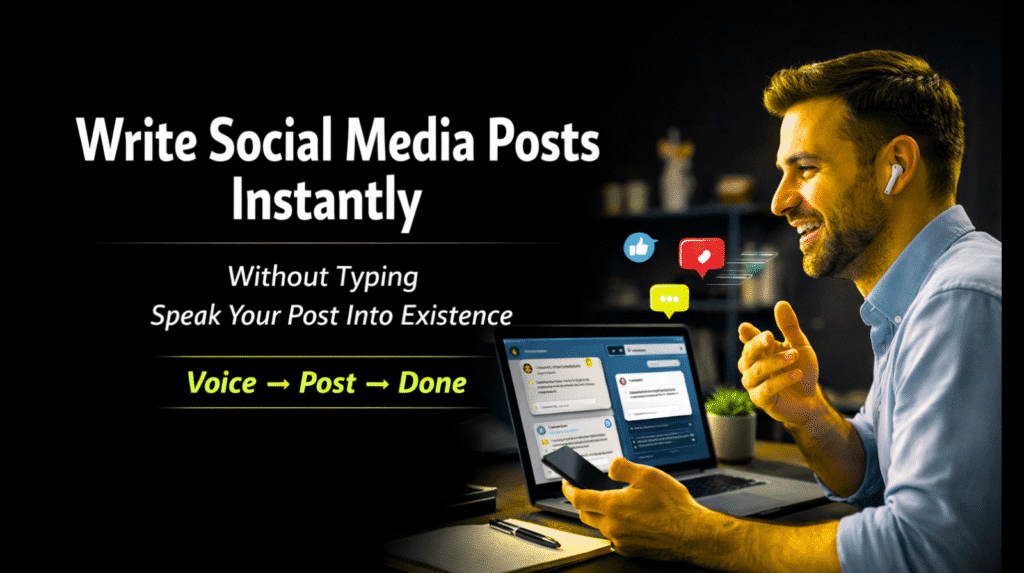
A new category of AI is changing how professionals approach social media work. Instead of writing posts line by line, professionals simply speak instructions such as:
“Create a LinkedIn post about today’s client meeting and schedule it for the evening.”
In this workflow, you are not dictating a caption. You are expressing intent. The AI understands what platform you are on, what tone is required, and how the post should be structured. The content appears directly in the input field, ready to publish.
This is called voice-to-action.
You do not type.
You do not copy.
You do not format.
You speak, and the action is completed.
How context-aware AI understands LinkedIn, X, and Instagram automatically
When AI works inside the browser and reads the environment you are working in, it does not need long prompts or explanations. It already understands:
- LinkedIn requires a professional, structured tone
- X requires short, engaging text
- Instagram requires conversational captions with hashtags
- Facebook requires informative, readable updates
This is known as context-aware AI. The AI adapts to the platform without you explaining it. The user experience becomes natural and conversational, not technical.
You remain on the platform, speak naturally, and the post appears correctly written for that environment.
From manual drafting to a browser AI agent that executes for you
This is where a browser-native AI agent changes everything. Instead of visiting a separate AI tool, you use AI directly inside the platform where the post will be published. There is no switching tabs, no transferring text, and no editing raw drafts.
The drafting phase disappears because the AI prepares the post exactly where it needs to be.
Genie007 represents this new way of working where social media posting becomes an execution task rather than a writing task.
Real professional scenarios where this changes daily work
A marketing manager wants to share a product update across platforms. Instead of writing separate posts, they say:
“Create posts for LinkedIn, X, and Facebook about our new feature and adjust the tone for each.”
A freelancer wants to maintain daily presence online:
“Write a LinkedIn post about productivity tips and schedule it for tomorrow morning.”
A founder finishes a meeting and wants to share an insight:
“Create a LinkedIn update about what I learned in today’s hiring discussion.”
In each case, the professional shares an idea, and the AI handles the writing and placement automatically.
Why this dramatically improves consistency on social media
The biggest barrier to social media growth is not lack of ideas. It is the time and effort required to draft posts regularly. When posting feels like work, consistency drops.
When posting requires only speaking an idea, consistency becomes natural.
This directly impacts:
- Personal branding
- Business authority
- Audience engagement
- Content frequency
You post more not because you try harder, but because the workflow becomes easier.
The weekly time cost you don’t notice
If drafting and scheduling one post takes fifteen minutes and you post across three platforms daily, you may spend several hours each week just typing, editing, and formatting social content.
With a voice-to-action workflow, this reduces to minutes per day. The time saved can be used for strategy, creativity, or client work instead of repetitive editing.
The gain is not only in time saved but in mental energy preserved.
The future of social media work in 2026 and beyond
We are moving toward a work style where keyboards are no longer the primary interface for repetitive communication tasks. Social media posting is one of the clearest examples of this shift.
Professionals will increasingly rely on ambient AI that operates in the background, ready to execute tasks when instructed. The traditional process of typing captions and formatting posts will begin to feel outdated.
The new workflow will be simple:
Speak your idea.
AI structures it.
The platform receives it.
You schedule and move on.
Old workflow vs new workflow
Old way of posting
- Think of an idea
- Open platform
- Type draft
- Edit tone
- Add hashtags
- Fix formatting
- Schedule
New way of posting
- Speak the idea
- Post appears ready
- Schedule
This is the difference between writing content and executing content.
Conclusion: Social media posting is no longer a writing task
Professionals do not need better writing skills to grow on social media. They need a better AI workflow that removes writing from the process entirely.
With context-aware, voice-to-action AI agents like Genie007, social posting becomes something you execute with a voice command rather than something you labor over with a keyboard.
And when that happens, staying visible online no longer feels like extra work. It becomes a natural extension of how you think and communicate throughout your day.
Frequently Asked Questions
How can I write social media posts without typing?
Modern voice-to-action AI tools allow professionals to speak instructions instead of typing posts. The AI understands the platform you are on and drafts the post directly in the input field, ready to publish.
What is the difference between voice typing and voice-to-action AI?
Voice typing converts speech into raw text that still requires editing and formatting. Voice-to-action AI understands your intent, the platform context, and creates a fully structured post automatically.
Can AI automatically adjust tone for LinkedIn, X, and Instagram?
Yes. Context-aware AI recognizes the platform you are using and adapts the writing style, tone, and format accordingly without needing extra prompts.
Why do AI writing tools still feel slow for social media posting?
Most AI tools generate text outside the platform, forcing users to copy, paste, edit, and format manually. The workflow remains fragmented and time-consuming.