
Understanding how voice typing works helps you use it better — and helps you tell the difference between tools that genuinely understand you and tools that are just fast at writing down what you say. How does voice typing work in 2026? The short answer is that modern AI voice recognition is built on transformer-based neural networks that model language statistically, not phonetically — and the best tools add a second layer of AI that converts what you said into what you actually meant. This guide explains the technology at a level that is genuinely useful without requiring a machine learning background.
Genie 007 is built on this modern architecture and goes one step further: its Genie Mode layer converts voice input into completed actions — writing emails, generating code, drafting documents, composing replies — rather than producing a transcript. The difference matters, and understanding how the technology works explains why. For a practical overview of what Genie 007 does with these capabilities, see the Genie 007 AI voice assistant guide.
How Voice Typing Works: The Science Behind Speech-to-Text
Voice typing technology did not begin with AI. The first generation of automatic speech recognition (ASR) — the kind in Dragon Naturally Speaking in the 1990s and early 2000s — used a technique called phoneme matching. The software broke down audio into the smallest units of sound in a language (phonemes), compared those sounds against a statistical model of which phoneme sequences most commonly corresponded to which words, and produced a best-guess transcription.
This approach had fundamental limitations. Phoneme matching is computationally intensive per word, which is why early Dragon required 20 to 30 minutes of voice training — the software was calibrating its phoneme models to the specific characteristics of your voice. Accuracy was heavily dependent on speaking at consistent pace, in a quiet environment, in a clear accent. Different speakers of the same language produce significantly different phoneme profiles, and the system struggled to generalise. Vocabulary was fixed: Dragon could only recognise words in its trained dictionary, so specialist terminology required manual vocabulary additions that users found cumbersome.
The accuracy plateau for traditional ASR was around 85 to 90 per cent under good conditions — meaning roughly one word in ten was wrong. At 150 words per minute, that is 15 errors per minute. Useful for some applications, but requiring heavy correction that often ate the speed advantage of speaking over typing.
How Modern AI Speech Recognition Works: The Transformer Approach
The shift that changed everything was the adoption of transformer neural network architectures for speech recognition — most visibly implemented in OpenAI’s Whisper model, which Genie 007’s transcription layer is built on. The difference in approach is fundamental.
Rather than matching sounds to phonemes, transformer-based models learn the statistical relationships between audio patterns and language sequences across massive datasets of real human speech. The model does not recognise words one at a time — it processes sequences of audio in parallel, applying attention mechanisms that weight different parts of the audio input against each other to determine the most likely complete phrase. This is why modern AI transcription handles overlapping words, natural speech patterns, and imperfect pronunciation so much more accurately than phoneme matching — it is predicting language, not decoding sound.
The practical result is accuracy of 99.5 per cent or better, no voice training required, performance across 140-plus languages, and resilience to accents, background noise, and natural speaking pace that traditional ASR simply could not match. The transformer model has effectively solved the transcription problem for most professional use cases.
The second key element of modern AI speech recognition is contextual language modelling. A transformer model does not just predict words based on audio — it predicts words based on audio combined with the linguistic context of everything said so far in the utterance. This is why modern AI transcription correctly distinguishes “I need to see the principle” from “I need to see the principal” based on context, not just phonetic similarity. The model understands that “principal” is more likely in a sentence about a school meeting. Traditional phoneme matching could not do this.
The Key Difference: Transcription vs Intent Understanding
Modern transformer-based ASR solves transcription. But transcription is not the same as intent understanding. A transcription engine writes down what you said. An intent-understanding system works out what you meant and acts on it.
The difference is clearer with an example. A transcription tool given the spoken command “professional reply to this email declining the meeting” produces the text: “professional reply to this email declining the meeting.” That is an accurate transcription — and completely useless as a reply. An intent-understanding system reads the email open on your screen, interprets the command as an instruction, and writes: “Thank you for the invitation — I am not able to attend on this occasion but would welcome the opportunity to connect at a different time. Please feel free to suggest an alternative date.” That is execution, not transcription.
This is where Genie 007’s Genie Mode enters the picture. Genie Mode is the AI layer that sits on top of the transcription engine. It receives the transcribed command, reads the contextual information from the screen — the email content, the open document, the Jira ticket, the code — and uses a large language model to determine what the appropriate output should be. The result appears in whatever text field you are working in. It is the difference between a secretary who writes down what you say and an assistant who does what you mean. For practical examples of voice-to-action commands, see the AI voice commands guide.
How Local Audio Processing Works
One of the most important architectural decisions in voice typing technology in 2026 is where processing happens. Cloud-based processing — where audio is streamed to remote servers, processed, and the result returned — has been the standard model for most voice services because the computational load of running large models historically required data centre hardware. The implication is that everything you say is transmitted to, and temporarily processed by, a third-party server.
Local processing runs the transcription model directly on the user’s device — on the CPU, GPU, or neural processing unit (NPU) available in modern computers. This is computationally feasible in 2026 in ways it was not five years ago. Apple Silicon Macs, modern Intel and AMD processors, and dedicated NPUs in recent Windows hardware all have sufficient throughput to run Whisper-class models locally at real-time speed.
Genie 007 processes all audio locally. The practical consequence is that no audio recording of anything you say is ever transmitted to any external server. Your words — whether you are dictating a confidential business strategy, a performance review, a legal document, or a personal message — never leave your machine during the transcription phase. No recordings are stored. Genie 007 is GDPR compliant and HIPAA ready precisely because the data handling architecture does not create the transmission and storage events that trigger compliance obligations in the first place. Full technical detail on local processing architecture is available on the security and privacy page.
Why Accuracy Jumped — and What 99.5 Per Cent Actually Means
The headline accuracy figure for modern AI voice typing is 99.5 per cent. To contextualise that: at 150 words per minute speaking speed, 99.5 per cent accuracy means approximately one word in 200 is transcribed incorrectly — roughly one error every 80 seconds of continuous speech. For practical professional use, errors at this rate are infrequent enough that most users review transcription output in the same way they would proofread typing, rather than performing systematic error correction.
The factors that drove accuracy from the 85 to 90 per cent ceiling of traditional ASR to 99.5 per cent for transformer models are: scale (Whisper was trained on 680,000 hours of multilingual audio, vastly more than any previous model), architecture (attention mechanisms that process context across the full utterance rather than word by word), and the inclusion of cross-language data that dramatically improved accent-variation handling far beyond monolingual models.
Custom vocabulary additions — available in Genie 007 for specialist terminology — effectively push accuracy for specific terms to near-perfect. If your field uses terminology that does not appear frequently in general speech (pharmaceutical compound names, legal citations, specific product models, industry jargon), adding those terms to Genie 007’s vocabulary dictionary ensures they transcribe correctly from the first use.
The Speed Stack: From Speaking to Finished Output
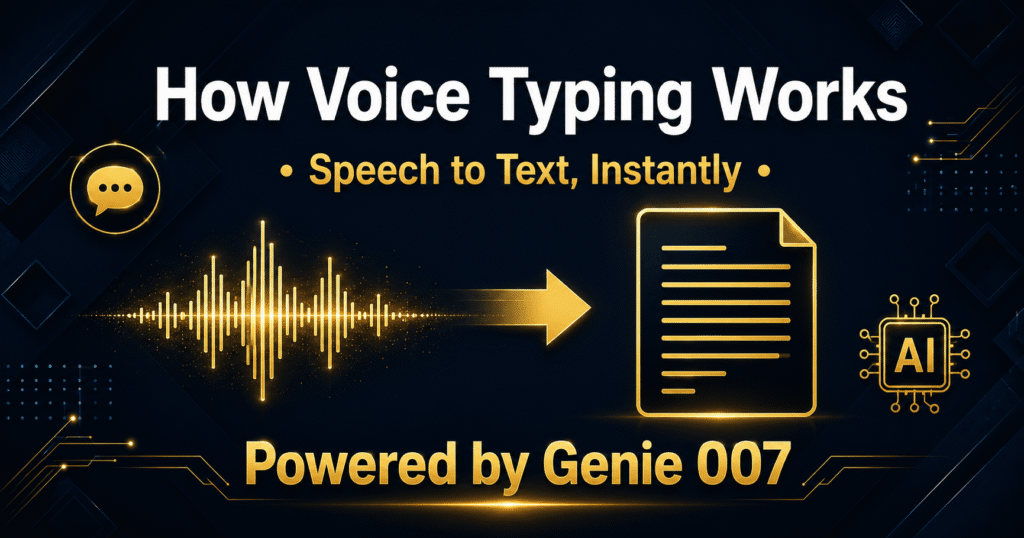
The complete pipeline from speaking to finished output in Genie 007 works as follows:
1. Audio capture. The microphone captures your voice. Genie 007 only activates when your configured hotkey is pressed — it does not record ambient audio or run continuously in the background.
2. Local transcription. The audio is processed by the Whisper-based model running on your device. No audio leaves the machine. Transcription is returned at approximately real-time speed — for a 5-second spoken command, the transcription is available within 1 to 2 seconds of the command ending.
3. Intent parsing (Genie Mode). If Genie Mode is active, the transcription is sent to the intent layer along with contextual information from the current screen — the open email, document, text field, or page content. The large language model interprets the command in context.
4. Output generation. The response is generated and placed into the active text field — whether that is a Gmail compose window, a Notion document, a Jira ticket, a Word document, or a chat input in Slack. The complete process from pressing the hotkey to seeing finished text in the field typically takes 2 to 4 seconds for a 10-to-20-word spoken command producing a full paragraph of output.
Frequently Asked Questions
How does voice typing handle background noise?
Modern transformer-based ASR models like the one in Genie 007 handle background noise far better than traditional phoneme-matching systems, because they model language statistically rather than matching exact phoneme patterns. For very noisy environments, using a directional microphone (such as a headset mic or a close-range desk mic) improves accuracy further, but standard laptop and desktop microphones in typical office environments produce reliable results.
Why does voice typing sometimes get names and technical terms wrong?
Proper nouns, brand names, and specialist technical terms appear infrequently in general speech training data, so the statistical model has less evidence to work from. This is why custom vocabulary support is important for professional use. Adding frequently used names and terms to Genie 007’s vocabulary dictionary — a two-minute task — resolves this for the specific terminology that matters in your work.
Does voice typing work for all languages?
Genie 007 supports 140 languages with 99.5% accuracy across all of them. Whisper’s training data includes substantial multilingual content, which means the model performs well across major world languages and many less widely spoken ones. Genie 007 also supports automatic mid-sentence language detection — if you switch languages within a single dictation session, it detects and handles the switch correctly.
Is voice typing secure for confidential information?
It depends entirely on whether audio processing is local or cloud-based. Cloud-based voice tools (Siri, Google Voice Typing, most web-based dictation services) transmit audio to remote servers. For confidential business, medical, or legal information, that transmission creates compliance and security risk. Genie 007 processes all audio locally — no audio is ever transmitted or stored. Full compliance details at genie007.co.uk/security-privacy.
What is the difference between voice typing and voice commands?
Voice typing (dictation) converts speech to text — you speak, it writes. Voice commands instruct software to perform actions — you say “open calendar,” it opens the calendar. Genie 007’s Genie Mode combines both: it transcribes your spoken instruction and then executes the intent of that instruction, producing completed text output (an email, a document, a code comment, a reply) rather than raw transcription. It is closer to voice commands than voice typing — but the output is text, not a UI action.
How fast is voice typing compared to typing?
Standard speaking speed is 130 to 150 words per minute. Average typing speed is around 40 words per minute. That is a three-to-four times speed advantage for dictation alone. With Genie 007’s Genie Mode, a 10-second spoken command can produce a complete 200-word email or document — output that would take 5 minutes to type — making the practical speed advantage for structured writing tasks far larger than the raw WPM comparison suggests.
Now you know how it works — experience the difference between transcription and voice-to-action for yourself. Install Genie 007 Free →
Related reading: voice typing for project managers, AI voice typing vs basic dictation, voice typing on Windows 11.