
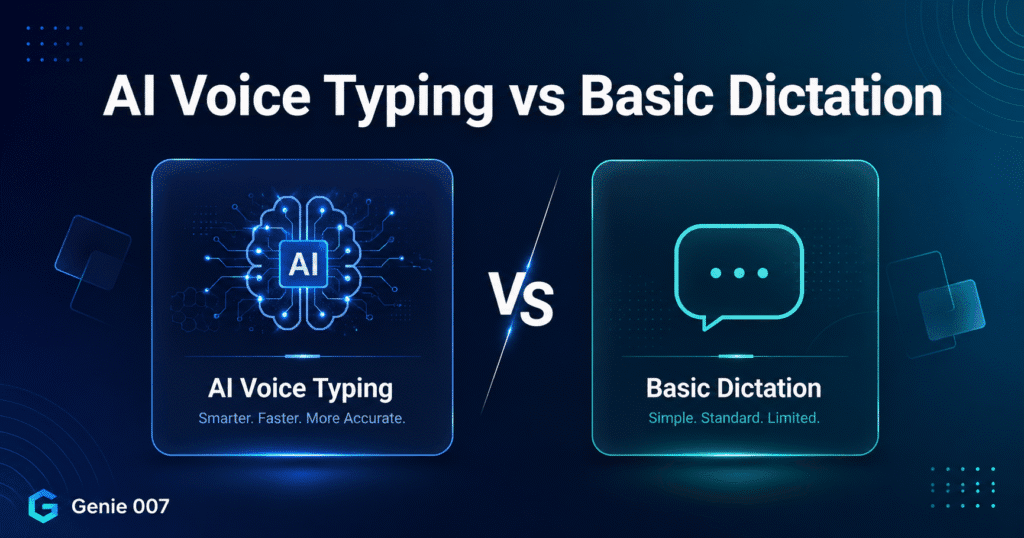
AI voice typing vs dictation is a question that matters more than most people realise — because the two things are fundamentally different in what they produce. Basic dictation tools write your words. AI voice typing understands your intent and produces completed work. For someone writing a simple note, the difference is minor. For someone who needs to produce polished emails, structured reports, precise code, or formatted documents, the difference determines whether voice is a marginal time-saver or a fundamental shift in how much you can produce. This guide explains what actually changes at each level — with real examples.
The Three Tiers of Voice Typing Technology
Voice typing tools do not all operate at the same level. Understanding the distinctions helps you choose the right tool for your actual use case — and explains why some people have tried voice typing and found it underwhelming while others rely on it as their primary input method.
Tier 1: Basic transcription. Apple Dictation (built-in), Windows 11 voice typing (Win + H), and most smartphone keyboard dictation features operate at this level. They convert speech to text with reasonable accuracy for everyday language. They write what you say, approximately as you say it. They have no understanding of what you are trying to produce, no ability to format output, no AI reasoning layer. For writing a short text message or a quick note to yourself, Tier 1 is adequate. For structured professional writing, it produces raw text that requires significant editing and formatting.
Tier 2: Accurate speech-to-text (STT). Whisper-based tools and dedicated dictation software (some Dragon NaturallySpeaking modes, Whisper API integrations) operate here. Accuracy is significantly higher — 98 to 99% versus 90 to 95% for Tier 1. Custom vocabulary support means specialist terminology is captured correctly. Speaker adaptation means the tool learns your speech patterns over time. The output is still transcription — accurate, clean transcription — but transcription only. You still need to structure, format, and contextualise the output yourself. Tier 2 saves typing time but does not reduce the cognitive work of writing.
Tier 3: Intent AI — voice to action. Genie 007 operates at this level. The tool does not just convert speech to text — it understands what you are trying to produce and produces it.
“Reply to this email professionally, accept the meeting but propose Thursday instead of Wednesday, and ask for an agenda” does not produce those words in a text field. It produces a complete, polished email reply, ready to send. The input is a command. The output is the finished task. This is what distinguishes voice-to-action from voice-to-text — explained in depth at what Genie 007 AI voice assistant actually does.
Smart Dictation vs AI Voice Typing: The Practical Test
The clearest way to evaluate smart dictation vs basic voice typing is a direct output comparison on the same task. Take a structured professional writing task — a formal email declining a meeting and proposing an alternative, or a CRM note summarising a sales call — and produce it using both methods.
Basic voice typing requires you to dictate every word of the final output. You are the composer; the tool is the transcription layer. The output quality depends entirely on how well you can compose while speaking, under the pressure of keeping your train of thought coherent in real time.
With smart dictation at Tier 3, you describe the output you need and let the AI compose. The instruction for the same email might be: “Decline the meeting request from David, thank him for the invitation, explain that the timing conflicts with our board preparation week, and propose the same meeting two weeks later on a Wednesday or Thursday, asking him to suggest a time.”
That 40-word instruction produces a complete, polished 150-word email. The composition work — which is the cognitively demanding part — is handled by the AI. You provide the intent, the facts, and the context. Genie 007 handles the translation into professional written form.
This distinction — between being the composer and being the director — is the practical essence of what is AI voice typing versus basic dictation. Basic dictation makes you a faster composer. AI voice typing changes your role from composer to director. For most professional writing tasks, the director role produces better output with less effort. The exceptions are creative or personal writing where the composing process itself has value — where the act of finding your own words is part of the point. For structured professional communication, the director role is almost always the better choice.
What Changes at Each Tier: Real Examples
The easiest way to understand the difference is to trace a single task through all three tiers.
Task: Reply to an email from a client asking for a project status update. The project is 80% complete, running one week behind schedule, and the delay is due to a third-party dependency that has now been resolved.
With Tier 1 (Apple Dictation, Windows built-in): You open the email reply field and dictate — word for word — the entire reply. “Dear Sarah comma thank you for your email full stop the project is currently at eighty percent completion full stop we are running approximately one week behind our original schedule due to a delay from a third-party supplier full stop that dependency has now been resolved and we are confident the project will be delivered by the end of next week full stop…” You produce the entire reply by speaking every word, comma, and full stop. Time saved: roughly equal to the difference between your typing speed and speaking speed, which for most people is modest. Editing still required for punctuation errors and formatting.
With Tier 2 (Whisper STT, quality dictation software): You dictate the same reply, but accuracy is higher. Punctuation is handled more reliably. You still dictate every word of the reply, but fewer corrections are needed afterwards. Time saved: meaningful versus typing, but you are still authoring every word of the reply. The cognitive work of composing is unchanged.
With Tier 3 — Genie 007: You activate Genie 007 in the email reply field and say: “Reply to Sarah’s email. Project is 80% complete, one week behind due to a third-party supplier delay that is now resolved, and we are confident of delivery by end of next week.” Genie 007 produces a complete, professionally written email reply — properly structured, appropriate in tone, with a greeting, clear status update, explanation, and confident closing. You review it in 10 seconds. Click send. Total time: under 45 seconds, including reading the output. The reply is better than most people would type in five minutes, because it has no filler language, no hedging, and appropriate professional tone throughout.
The multiplier at Tier 3 versus Tier 1 is not just the typing-versus-speaking speed difference. It is that Tier 3 produces outcomes while Tier 1 produces words. For structured tasks — emails, reports, code functions, social posts, meeting summaries — the output volume per unit of voice input is 20 to 30 times higher at Tier 3 than at Tier 1. The speaking-versus-typing speed advantage of 130 WPM versus 40 WPM (see the data at dictation versus typing speed) is the floor, not the ceiling, of what voice-to-action delivers.
Who Actually Needs Each Tier
Not everyone needs Tier 3. This matters, because overstating the case for AI voice typing for every use case undermines trust in the genuine value proposition. Here is an honest breakdown.
Tier 1 is sufficient for: casual personal notes, short messages to friends, basic reminders, situations where you just need words on screen quickly and the output is informal. If your voice typing use case is dictating a shopping list or sending a quick chat message, Tier 1 is perfectly adequate and adding complexity adds no value.
Tier 2 is worth it for: high-volume transcription of structured content you are fully composing yourself — long-form documents where you want to think and speak rather than think and type, technical fields where specialist terminology accuracy is critical, and situations where you have a physical reason (repetitive strain, disability, accessibility needs) to avoid keyboard input. Tier 2 removes the physical bottleneck but keeps you in the composition driver’s seat.
Tier 3 is the right choice for: professionals who produce structured written outputs at volume — emails, reports, CRM notes, code, social content, legal documents, academic writing, journalistic drafts. Anyone who spends more than two hours a day composing structured text will find Tier 3 multiplies their output in ways that Tier 1 and Tier 2 cannot approach. The more structured and purposeful your writing, the larger the Genie 007 advantage.
For a practical comparison of Genie 007 with other voice typing tools, the security and privacy architecture is also worth reviewing — because at Tier 3, where you are processing your actual work through a voice AI, the data model matters as much as the output quality.
The Research Behind AI Productivity Multipliers
The claim that AI voice typing produces 20 to 30 times more output than basic transcription for structured tasks is specific and worth grounding in evidence. The components of the multiplier are: the speaking-versus-typing speed advantage (approximately 3x, based on 130 WPM speech versus 40 WPM typing — detailed at dictation versus typing speed, and consistent with research on speech versus keyboard input rates); the elimination of structural composition work (the time spent turning raw thoughts into organised paragraphs, which research on writing behaviour shows accounts for 40 to 60% of total document production time); and the reduction in editing time when AI produces well-structured output versus raw transcription (typically 50 to 70% less editing needed for structured Genie Mode output versus Tier 1 transcription of the same content).
These multipliers compound. For a 400-word professional email: Tier 1 might take 10 minutes of dictation plus 5 minutes of editing, total 15 minutes. Tier 3 takes 30 seconds of spoken command plus 2 minutes of review, total 2.5 minutes. The ratio is 6x on this example — less than the 20 to 30x claim, because short emails compress the advantage. For a 2,000-word report, the multiplier is larger: Tier 1 produces a transcript requiring full restructuring and rewriting, while Tier 3 produces a structured draft requiring review and fact-checking adjustment. The ratio in total time invested approaches the 20 to 30x range for complex structured documents. The productivity case for what is AI voice typing versus basic dictation is strongest precisely where the writing task is most demanding.
Genie Mode: The Clearest Example of Tier 3
Genie Mode is Genie 007’s primary command interface and the clearest demonstration of voice-to-action. In Genie Mode, you issue a structured instruction and Genie 007 produces the specified output in whatever application you have open. The instruction can be simple or complex. It can specify format, tone, length, structure, audience, and intent. The output appears directly in the active application — no copy-pasting, no app-switching, no additional steps.
Representative Genie Mode commands and their outputs:
- “Write a Python function that validates an email address using a regular expression and returns true or false” — complete, documented Python function, ready to use
- “Summarise these meeting notes into five action items with owner and deadline” — structured action list, formatted for your document
- “Turn this paragraph into a LinkedIn post — professional tone, under 200 words, end with a question to drive engagement” — polished LinkedIn post, ready to publish
- “Draft a performance review for a team member who has hit all targets but needs to improve on documentation quality” — complete review in appropriate HR format
In each case, the input is a short spoken command. The output is the completed task. This is the definition of voice-to-action versus voice-to-text. Privacy is preserved throughout: Genie 007 processes all voice input locally on your device, with no audio stored and no data sent to external servers. See the Genie 007 security and privacy page for the full technical architecture.
Frequently Asked Questions
What is the difference between voice typing and voice to action?
Voice typing converts your speech into text — it writes what you say. Voice to action interprets your spoken command and produces the specified output. If you say “write a professional email declining this meeting,” voice typing produces those words in your document. Voice to action (Genie 007) produces a complete, polished email declining the meeting, ready to send. The input is a command; the output is the finished task. The distinction sounds technical but it is completely practical — one saves you some typing time, the other changes what your voice can accomplish.
Is AI voice typing worth the upgrade from basic dictation?
For casual personal use, probably not. For professional use where you produce structured written outputs — emails, reports, documents, code, client communications — yes, substantially. The Tier 3 multiplier (20 to 30 times more output per unit of voice input for structured tasks) reflects a real and measurable difference in what you can produce in a working day. For anyone spending more than two hours daily on written communication, the productivity case for AI voice typing is strong.
Does AI voice typing replace the need to write?
It replaces the mechanical process of writing — the physical typing and the structural composition effort. It does not replace the judgment, expertise, and knowledge that make the writing valuable. You still decide what to communicate, what positions to take, what information to include or exclude. Genie 007 handles the translation from your intent to polished written output. You remain the expert; Genie 007 removes the friction between your knowledge and the page.
How accurate is AI voice typing compared to basic dictation?
Basic dictation (Tier 1) typically achieves 90 to 95% accuracy on standard language. High-quality STT tools (Tier 2) reach 98 to 99% accuracy with speaker adaptation. Genie 007 achieves 99.5% accuracy across 140 languages with custom vocabulary support. But accuracy comparison between Tier 1 and Tier 3 somewhat misses the point — the primary Tier 3 advantage is not accuracy on transcription, it is the shift from transcription to execution. Genie 007 produces the right output for your task, not just an accurate transcript of your words.
Can basic dictation and AI voice typing coexist in the same workflow?
Yes, and this is actually a common pattern. Tier 1 (built-in OS dictation) handles casual quick inputs — short messages, simple notes. Genie 007 handles structured professional outputs — emails, documents, code. Many users activate Genie 007 for professional work and use the built-in shortcut for incidental text entry. The two capabilities complement rather than replace each other, depending on the task at hand.
Related reading: voice typing on Windows 11, voice typing for journalists, voice typing for sales reps.
Move beyond transcription and start producing outcomes with your voice. Install Genie 007 Free →
Written by Bill Kiani, founder of Genie 007.