
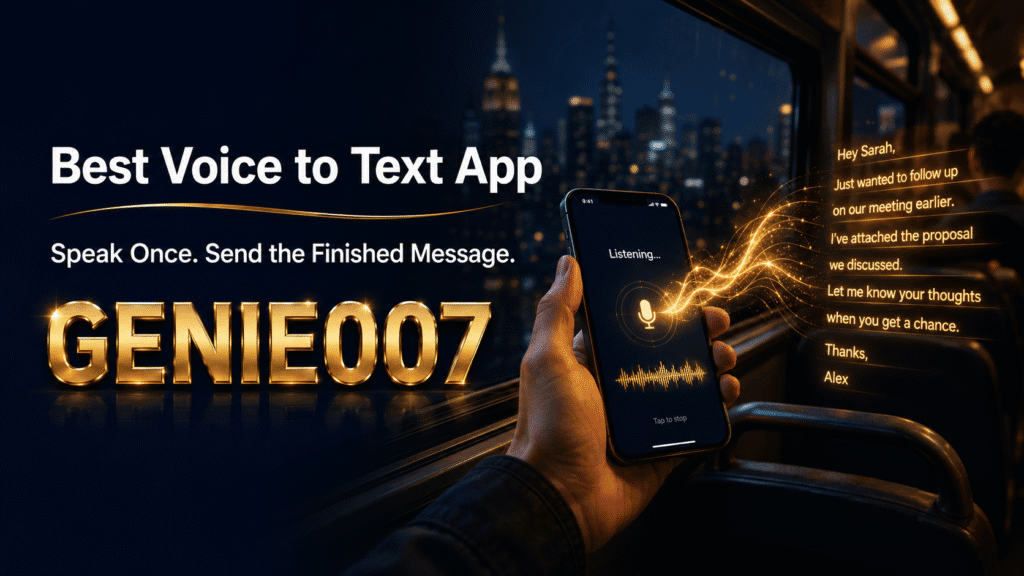
The best voice to text app for most people in 2026 is already installed on their phone — and the companies selling £100-a-year subscriptions would rather you did not know that. Gboard on Android and Apple Dictation on iPhone are free, quick, and accurate enough for texts, notes and short replies, and nothing beats “free and pre-installed” for that job.
The honest question is not “which app should I download?” but “when do the free tools stop being enough?” This guide answers both. We start with the built-in options and exactly how to switch them on, move to the paid apps that genuinely add something, and finish with a newer category — think-to-text — for people who are tired of dictating every single word and then fixing the result.
The Quick Answer
If you only read one section, read this one. There is no single best voice to text app for every person — there is a best app per job, and the table below matches the most common jobs to the right tool for a phone in 2026.
| What you need | Best pick | Cost |
|---|---|---|
| Free texting and notes on Android | Gboard voice typing | Free |
| Free dictation on iPhone | Apple Dictation | Free |
| Recording and transcribing meetings | Otter.ai | Free tier; paid from around $8/month |
| Premium AI dictation across apps | Wispr Flow | $15/month |
| Turning rough thoughts into finished messages | Genie 007 | From £5/month |
One distinction matters before we go further. A talk to text app writes as you speak, live, into whatever text field you are in. A transcription service processes recordings after the fact. This article focuses on the first kind — writing with your voice in real time — with a short detour for Otter, which sits in the second camp but turns up in every comparison anyway.
Free Built-In Options: The Voice to Text App You Already Own
Before paying anyone, switch on what your phone ships with. Both platforms give you a voice to text app free of charge, built into the keyboard, working in every app that accepts text — WhatsApp, email, notes, browsers, all of it.
Neither requires an account, neither shows ads, and both have improved noticeably over the past two years thanks to on-device speech models. Here is how to get the most from each.
Gboard Voice Typing (Android)
Gboard is Google’s keyboard and comes pre-installed on most Android phones. Tap into any text field, press the microphone icon at the top right of the keyboard, and speak. Per Google’s Gboard documentation, you can also download language packs for offline voice typing on supported devices, which keeps dictation working on the Tube or on a flight.
For everyday language it is fast and reliable, and automatic punctuation now works well on many handsets. The experience is markedly better on Pixel phones: Pixel 6 and newer run recognition on-device, which speeds things up, keeps audio on the phone, and adds spoken editing commands such as “delete” and “clear”. Recent Pixels layer on voice-driven rewriting tools that also run on-device.
The catches: quality varies widely between manufacturers, unusual names and technical jargon trip it up, and it transcribes exactly what you say — hesitations, false starts and all. For setup details across Samsung, Pixel and other brands, see our full guide to voice typing on Android.
Apple Dictation (iPhone)
On iPhone, dictation lives behind the microphone key on the keyboard. If it is off, enable it under Settings, General, Keyboard, then Enable Dictation. On iPhone XS or newer running iOS 15 and later, everyday dictation is processed on the device itself, as described in Apple’s dictation guide, and automatic punctuation inserts commas, full stops and question marks as you speak.
Two touches make it pleasant to use: you can type and dictate at the same time without dismissing the keyboard, which is handy for fixing an error mid-flow, and since iOS 18 you can mix two languages in a single dictation session. In a quiet room with clear speech, accuracy is high.
The trouble starts with background noise, strong accents, and medical, legal or industry-specific terminology, where the literal transcript needs real cleanup. Language coverage is also far narrower than dedicated apps offer. We dug into the settings that matter most in our best dictation app for iPhone guide.
Other Free Options Worth a Look
Speechnotes on Android offers continuous, no-frills dictation into a notepad — useful for long brain-dumps, though you then copy and paste the result wherever it actually needs to go. Google’s Recorder app on Pixel transcribes voice memos impressively, but it is a notes tool, not a keyboard.
The pattern across every voice to text app free tier is the same: the transcription itself costs nothing, and everything around it — formatting, cleanup, moving text between apps — is where you pay in time instead of money.
Where Free Talk to Text Apps Hit Their Ceiling
Speaking is roughly three times faster than typing on glass — we ran the numbers in our dictation vs typing speed comparison — but raw speed is not the bottleneck. Editing is. A literal transcript of natural speech is full of “um”, repeated words and sentences that trail off, and tidying that up on a five-inch screen often eats most of the time you saved.
Built-in tools also stop at transcription. They do not know that a Slack message should be casual and a client email should not. They cannot take “tell Sarah I’m running twenty minutes late and ask if we can push the call” and produce the actual message. You have to dictate every word yourself, in order, correctly, the first time — which is a skill most of us do not have and do not want to practise.
Then there are the hard limits: silence timeouts that cut you off mid-thought, patchy support beyond the major Western languages, no translation, and — on many non-Pixel Android phones — cloud processing you get little visibility into. None of this matters for a two-line text. All of it matters once your phone becomes the place you do real work.
Paid Voice to Text Apps: The Main Contenders
If you dictate more than a handful of messages a day, a paid tool can earn its keep. These are the names that come up most in 2026, with honest strengths and weaknesses.
Wispr Flow is the best-known AI dictation app. It cleans your speech as you talk — stripping fillers, formatting output for the app you are in — and after building its base on Mac, Windows and iOS, it added Android in early 2026. Pro costs $15 a month, with a limited free tier. Two things to weigh: processing happens in the cloud, so audio leaves your device every time you dictate, and there is no offline mode.
Otter.ai is a meeting transcription service rather than a keyboard. It records conversations and produces transcripts, summaries and action items, with a free plan covering 300 minutes a month at up to 30 minutes per conversation. It is genuinely good at that job — and the wrong tool entirely if what you want is to write messages by voice.
Dragon remains the legacy name for professional dictation, and it still wins for specialised enterprise vocabularies on the desktop. Its mobile offering, though, is dated and priced for institutions rather than individuals, so few phone-first users should start there.
| App | Price | Mobile platforms | Processing | What it does |
|---|---|---|---|---|
| Gboard / Apple Dictation | Free | Android / iOS | On-device on newer phones | Literal transcription |
| Wispr Flow | $15/month | iOS, Android | Cloud, no offline mode | AI-cleaned transcription |
| Otter.ai | Free tier; paid from ~$8/month | iOS, Android | Cloud | Meeting transcripts and summaries |
| Genie 007 | £5–£10/month | iOS, Android, plus desktop and browser | On-device, zero data retention | Writes finished messages from your intent |
Beyond Dictation: The Think-to-Text Upgrade
Every app above shares one assumption: your job is to speak the final text, word by word. Think-to-text drops that assumption. Instead of dictating a message, you describe what you want, and the tool writes it. We explain the idea properly in what is think-to-text, but the short version is the difference between dictating a letter and briefing a good assistant who only needs the gist.
Genie 007 is built around this. In Genie Mode you might say: “reply to this WhatsApp — can’t make Friday, suggest Tuesday lunch instead, keep it warm.” It produces the actual reply, in your tone, matched to the platform: casual for WhatsApp, professional for a client email, punchy for LinkedIn. You can refine it by voice before sending. No dictating word by word, no cleanup afterwards.
When you do want word-for-word control, its Voice Typing mode handles classic dictation with automatic punctuation and your personal writing style across 140+ languages. Live translation is built in too: speak in Polish, Urdu or Spanish and send polished English — something none of the built-ins offer.
Privacy is the other real differentiator. Processing happens on-device with AES-256 encryption, no audio storage and zero data retention; the service is GDPR compliant and HIPAA ready. If you dictate client work, patient notes or anything commercially sensitive on your phone, that matters more than any accuracy score.
The Genie 007 mobile app works inside WhatsApp, Gmail, LinkedIn, Slack and anywhere else you type, and one account also covers the Windows and Mac apps and a browser extension. Plans start at £5 a month, with Ultra at £10 — current details are on the pricing page — and the free trial needs no credit card.
To be clear about who should not pay: if you send the odd text and nothing more, stay with Gboard or Apple Dictation. Genie 007 earns its fee when you write at volume, work across languages, or need drafts rather than transcripts.
How to Choose the Best Voice to Text App for You
The best voice to text app for you comes down to the volume and the stakes of what you write on your phone:
- A few texts a day: stick with Gboard or Apple Dictation. Free wins, and both are better than their reputation.
- Meetings and interviews: Otter.ai’s free tier, upgrading only if you regularly pass 300 minutes a month.
- Heavy dictation, cleaner transcripts: Wispr Flow, provided cloud-only processing does not bother you.
- Dozens of messages, posts and emails daily, multilingual work, or sensitive content: a think-to-text tool such as Genie 007, at a third of the price of most premium rivals.
A useful rule of thumb: if you spend more time correcting transcripts than you saved by speaking, you have outgrown transcription — the fix is not a more accurate transcriber but a tool that writes the message for you.
Frequently Asked Questions
What is the best free voice to text app?
Gboard on Android and Apple Dictation on iPhone are the best free voice to text apps in 2026, because both are built into the keyboard, work inside every app, add punctuation automatically, and run on-device on recent phones — with no download, account or subscription required. Third-party free apps rarely beat them for everyday dictation.
Is there a talk to text app that adds punctuation automatically?
Yes. Apple Dictation inserts commas, full stops and question marks automatically in supported languages, and Gboard does the same on many Android phones, with the most reliable results on Pixel 6 and newer. Paid apps such as Wispr Flow and Genie 007 go further, formatting whole paragraphs and matching the style of the app you are writing in.
How accurate is voice to text on a phone?
In quiet conditions with clear speech, built-in phone dictation is accurate enough that most sentences need no correction at all. Accuracy drops noticeably with background noise, strong regional accents, unusual names and technical jargon — which is exactly where paid tools with better language models, custom vocabulary and AI cleanup justify their cost.
What is the difference between a voice to text app and a transcription app?
A voice to text app writes live into any text field as you speak, replacing the keyboard, while a transcription app processes a recording afterwards and hands you a document. Use the first for messages, emails and notes; use the second, such as Otter.ai, for meetings and interviews you need on record.
Try Genie 007 Free
If half your working day now happens on your phone, stop typing it out letter by letter. Say the thought once and let Genie 007 deliver the finished message, post or email — in your style, in any of 140+ languages.
Download Genie 007 free — available for Windows, Mac, mobile and as a browser extension. No credit card required.
Written by Bill Kiani, founder of Genie 007.