
Voice typing not working Chrome is one of the most frustrating issues for Chrome users. You click the microphone. Nothing happens. Or worse — it worked yesterday and now it doesn’t.
Voice typing not working in Chrome is one of the most frustrating tech problems because the error messages are useless, the fixes aren’t obvious, and the issue can be caused by a dozen different things: microphone permissions, browser settings, extension conflicts, operating system privacy controls, or the website itself blocking voice input.
You’re left clicking the same button repeatedly, wondering if Chrome is broken or if you are.
This guide covers every common cause of voice typing failure in Chrome and the exact fix for each one. We’ll work through the problems in order of likelihood — starting with the issues that affect 80% of users and working down to the edge cases.
If your voice typing stopped working or never worked in the first place, one of these fixes will solve it. And if you’re tired of troubleshooting Chrome’s finicky voice typing entirely, we’ll show you an alternative that eliminates these problems permanently.
Fix 1: Voice Typing Not Working Chrome — Check Microphone Permissions
This is the most common cause of speech to text not working Chrome — and the easiest to fix.
Chrome blocks microphone access by default for most websites, and a single accidental “Block” click during a permission prompt will prevent voice typing from working until you manually reverse it.
Open Chrome Settings (click the three-dot menu, then Settings). Navigate to Privacy and Security, then Site Settings.
Scroll down to Microphone under the Permissions section. Check two things: first, make sure the correct microphone is selected in the dropdown at the top.
If you’ve connected a USB headset or Bluetooth microphone since you last used voice typing, Chrome might be pointing at the wrong audio input. Second, look at the “Not allowed to use your microphone” list.
If the website where voice typing isn’t working appears here, click the three-dot menu next to it and select “Remove” or “Allow.”
You can also check permissions for a specific site by clicking the lock icon (or tune icon) in Chrome’s address bar while on the page where voice typing fails.
This shows the current permission state for that specific site — if Microphone is set to “Block,” change it to “Allow” and reload the page.
Fix 2: Voice Typing Not Working Chrome — OS Microphone
Even if Chrome’s permissions are correct, your operating system might be blocking microphone access at a higher level. This is common on Windows 10/11 and recent versions of macOS, which have privacy controls that override browser-level permissions.
Windows: Open Settings (Win+I). Go to Privacy and Security, then Microphone.
Make sure “Microphone access” is toggled on.
Scroll down and make sure “Let desktop apps access your microphone” is also enabled — Chrome is classified as a desktop app, so this toggle must be on even if Chrome has its own permission set to Allow.
Mac: Open System Settings. Go to Privacy and Security, then Microphone. Make sure Google Chrome is in the list and the toggle is enabled.
If Chrome isn’t listed, you may need to remove and re-add it, or reset the microphone permission by running tccutil reset Microphone com.google.Chrome in Terminal.
After changing OS-level permissions, quit Chrome completely (not just close the window — actually quit the application) and reopen it. OS permission changes often don’t take effect until Chrome restarts.
Fix 3: Voice Typing Not Working Chrome — Hard Refresh
Cached JavaScript errors can break voice typing on a page even when all permissions are correct. A standard refresh (F5 or Ctrl+R) reloads the page but may keep the cached scripts that are causing the problem.
Press Ctrl+Shift+R on Windows/Linux or Cmd+Shift+R on Mac to perform a hard refresh. This clears cached JavaScript, resets the microphone connection, and forces the page to re-request permissions from scratch.
For Google Docs specifically, this fixes the majority of “voice typing greyed out” issues because it reloads the Web Speech API connection that Google Docs depends on.
Fix 4: Voice Typing Not Working Chrome — Extensions
Browser extensions are a common hidden cause of chrome dictation fix problems.
Ad blockers, privacy extensions, and other speech-related tools can interfere with voice typing in several ways: blocking the Web Speech API that Google Docs uses, intercepting microphone access before the website receives it, or injecting JavaScript that conflicts with the page’s own voice typing code.
To test this, open Chrome in Incognito mode (Ctrl+Shift+N). Extensions are disabled by default in Incognito, so if voice typing works there but not in your normal browser window, an extension is the culprit.
To identify which one, go to chrome://extensions and disable extensions one at a time, testing voice typing after each disable.
Common offenders include uBlock Origin (in strict mode), Privacy Badger, NoScript, Ghostery, and ironically, other speech-to-text extensions that conflict with the page’s built-in voice typing.
Fix 5: Voice Typing Not Working Chrome — Update Chrome
Outdated Chrome versions occasionally have bugs in the Web Speech API that prevent voice typing from functioning. Chrome updates frequently, and voice-related features are occasionally broken in specific versions and fixed in the next update.
Go to chrome://settings/help or click Menu, then Help, then About Google Chrome. Chrome will check for updates and install them automatically.
After updating, restart Chrome completely.
If voice typing broke after a recent Chrome update (and you confirmed this by checking your Chrome version), it’s likely a known bug that will be fixed in the next update — but the alternative approach at the end of this article works regardless of Chrome version.
Fix 6: Voice Typing Not Working Chrome — Language Settings
Google Docs Voice Typing only supports specific languages, and if your document’s language is set to one that isn’t supported, the voice typing option will be greyed out or non-functional.
In Google Docs, go to File, then Language, and make sure the document language is set to a supported language (English, Spanish, French, German, and other major languages are supported).
If you’re working in a less common language, Google’s built-in voice typing may not support it at all — in which case you need a third-party voice typing tool that supports more languages.
Fix 7: Voice Typing Not Working Chrome — Test Microphone
Before assuming the problem is with Chrome or the website, verify that your microphone is actually working at the hardware level.
Quick test on Windows: Open Settings, then System, then Sound. Under Input, speak into your microphone and watch the input level meter.
If it doesn’t move, your microphone isn’t being detected by Windows — check your physical connection, try a different USB port, or check Bluetooth pairing.
Quick test on Mac: Open System Settings, then Sound, then Input. Select your microphone and speak — the input level should respond. If it doesn’t, check your physical connection or Bluetooth pairing.
Browser-level test: Visit a microphone testing website like webcammictest.com or onlinemictest.
com in Chrome. If the test site detects your microphone and shows audio input, the hardware is fine and the problem is specific to the website or extension you’re trying to use voice typing with.
Fix 8: Voice Typing Not Working Chrome — Clear Site Data
Corrupted site data can break voice typing on specific websites. This is more common than you’d expect — especially on Google Docs, which caches extensive application data that can become corrupted after updates.
In Chrome, click the lock/tune icon in the address bar while on the affected site. Click “Site settings.” Click “Clear data.”
This removes cookies and cached data for that specific site without affecting your other browsing data. Reload the page after clearing and try voice typing again.
For a more thorough approach, go to chrome://settings/content/all and find the specific site. Click the trash icon to remove all data for that site. This is the nuclear option for site-specific issues and resolves almost all data-corruption-related voice typing failures.
Fix 9: Voice Typing Not Working Chrome — Flags
Chrome’s experimental flags can occasionally affect speech recognition. If you’ve ever changed Chrome flags (at chrome://flags), a speech-related flag might be causing the problem.
Go to chrome://flags and search for “speech” or “audio.” If any flags are set to something other than “Default,” reset them to Default and restart Chrome.
Specifically, look for flags related to Web Speech API, speech recognition, or audio input — non-default settings here can break voice typing.
Why Voice Typing Not Working Chrome Issues Occur
The fundamental problem isn’t your settings or your microphone — it’s the architecture.
Google Docs Voice Typing and most Chrome-based voice typing tools rely on Google’s Web Speech API, which is a cloud-dependent service that sends your audio to Google’s servers for processing.
This creates multiple failure points: your microphone must work, Chrome must have permission, your OS must allow it, the Web Speech API service must be available, your internet connection must be stable, and no extensions can interfere with the API call.
A failure at any single point in this chain breaks voice typing entirely — and the error feedback is usually just silence.
This is why users experience intermittent failures: voice typing works perfectly for days, then suddenly stops. A Chrome update changed a setting. An extension updated and introduced a conflict.
Google’s speech service had a momentary outage. The OS pushed a privacy update that reset microphone permissions. Each of these causes the same symptom — nothing happens when you click the microphone — but each requires a different fix.
The Alternative: Voice Typing That Just Works
If you’re tired of troubleshooting, there’s a simpler approach.
Genie 007 provides voice typing that works independently of Google’s Web Speech API, operates across every website and application, and processes speech locally on your device — eliminating the cloud dependency that causes most Chrome voice typing failures.
Why Genie 007 avoids these problems: it processes audio locally on your device using its own AI model, so it doesn’t depend on Google’s speech service availability or your internet connection speed.
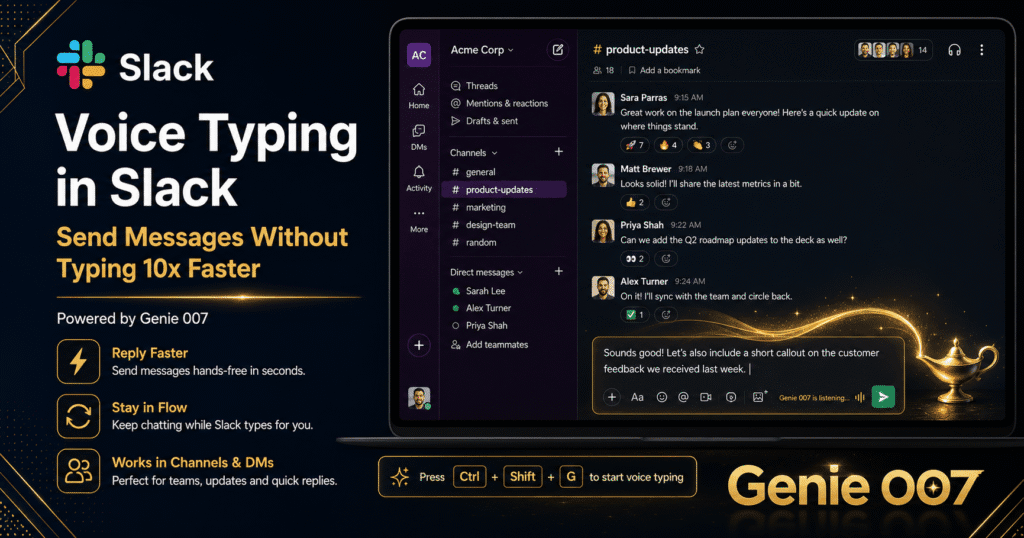
It works on every website — not just Google Docs — including Gmail, Slack, Notion, CRMs, and any page with a text input.
It works in every browser (Chrome, Firefox, Safari, Edge, Brave), so browser-specific bugs don’t affect it. And the desktop application provides system-wide voice typing that works in non-browser applications like VS Code, Cursor, desktop email clients, and terminals.
The setup takes 30 seconds: install from the Chrome Web Store, click into any text field, and start speaking. No API dependencies, no cloud processing, no permission chains that break silently.
For details on how it works, read the technology overview and security and privacy guide.
Frequently Asked Questions About Voice Typing Not Working Chrome
Why does Google Docs voice typing work in Incognito but not in my normal browser?
This confirms an extension conflict. Extensions are disabled in Incognito by default.
Disable your extensions one at a time in your normal browser window to identify which one is interfering. Common culprits are ad blockers, privacy tools, and other speech-related extensions.
Voice typing works on one computer but not another — why?
The most likely cause is different OS privacy settings between the two computers. Check that the microphone permissions at the operating system level (not just Chrome’s permissions) are correctly configured on the computer where voice typing fails.
Windows 11 in particular has multiple layers of microphone privacy controls.
Why is the voice typing option greyed out in Google Docs?
Three common causes: the document language is set to an unsupported language (check File → Language), you’re using a browser other than Chrome (Google Docs voice typing only works in Chrome), or Chrome doesn’t have microphone permission for docs.google.
com (check the lock icon in the address bar).
My microphone works for video calls but not for voice typing — why?
Video call applications (Zoom, Teams, Meet) manage their own microphone connections independently. Chrome’s voice typing uses the Web Speech API, which has its own permission and connection requirements.
Having a working microphone for calls doesn’t guarantee it works for Chrome’s speech recognition. Check Chrome-specific microphone permissions as described in Fix 1 and Fix 2 above.
Does clearing Chrome’s cache fix voice typing permanently?
Clearing cache fixes voice typing caused by corrupted site data, but the problem can recur if the underlying cause (an extension conflict, an OS setting, or a Chrome bug) isn’t addressed.
For a permanent solution that doesn’t depend on Chrome’s built-in voice typing, use an independent tool like Genie 007 that processes speech locally and doesn’t rely on the Web Speech API.
Stop Troubleshooting Voice Typing Not Working Chrome
Chrome’s voice typing is fragile because it depends on a chain of permissions, services, and settings that break independently and silently.
Every fix in this guide addresses a real problem — but if you find yourself returning to this article repeatedly, the architecture is the issue, not your configuration.
A voice typing tool that processes speech locally, works across every website and application, and doesn’t depend on Chrome’s speech APIs eliminates these failure points entirely.
Install Genie 007 and stop troubleshooting. Explore the alternatives comparison to see how it stacks up, and read the privacy guide to understand why local processing matters.
Try Genie 007 — Fix Voice Typing Not Working Chrome Permanently
No permissions issues. No Chrome bugs. No cloud dependency. Install Genie 007 from the Chrome Web Store and start voice typing in 30 seconds.
Get Genie 007 for Chrome — Free, forever. No credit card. Works on every website, every browser, every application.
Written by Bill Kiani, founder of Genie 007.
Related: AI Dictation vs Transcription: What Is the Difference?